A carbon fiber enclosure combines low weight, high structural rigidity, and a distinctive surface appearance. It is used in equipment where mass reduction and mechanical performance are critical design priorities. Selecting the right carbon fiber enclosure requires attention not only to the base material but also to structural layout, mounting methods, cutouts, sealing, electrical performance, and manufacturing process. This article examines the advantages, real-world applications, design considerations, and production methods of carbon fiber enclosures to help you determine whether the material suits your requirements.
What Is a Carbon Fiber Enclosure?
A carbon fiber enclosure is a protective housing manufactured from carbon fiber reinforced polymer (CFRP). It consists of carbon fiber layers embedded in a resin matrix, creating a composite structure with high strength and stiffness.
Carbon fiber enclosures can be manufactured in different forms, including equipment housings, protective covers, electronic cases, and custom structural shells. A carbon fiber electronics enclosure, for example, may require additional considerations such as electromagnetic interference (EMI) shielding, heat dissipation, and electrical insulation.
Why Use a Carbon Fiber Enclosure?
Five primary performance attributes drive adoption.
Lightweight Design
One of the main reasons to choose carbon fiber is weight reduction. Carbon fiber composite materials offer high mechanical performance at lower density than many metals. The density of typical carbon-fiber laminates lies between 1.5 and 1.6 g/cm³, compared with 2.7 g/cm³ for aluminum and 7.8 g/cm³ for steel. At equivalent strength, mass reductions of 40 % or more are routinely achieved. Lower mass reduces the inertial loads transmitted to internal components during shock or vibration events and improves system-level energy efficiency in mobile platforms.
High Strength and High Stiffness
Carbon fiber laminates exhibit specific stiffness values several times higher than aluminum alloys. The elevated natural frequency of a lighter, stiffer carbon fiber enclosure improves decoupling from the mounting structure and often yields better shock and vibration performance than a heavier metal counterpart of the same overall dimensions.
Corrosion Resistance
The composite does not rust or oxidize. It maintains structural integrity in humid, saline, or chemically aggressive environments, reducing long-term maintenance relative to steel or untreated aluminum housings.
Dimensional Stability
The coefficient of thermal expansion of carbon-fiber laminates is low and can be engineered to approach that of Invar. Dimensional changes over wide temperature ranges remain small, which is advantageous for precision electronics, optical assemblies, and tightly toleranced sealing surfaces.
Electrical Properties
Carbon fibers are electrically conductive. A carbon fiber electronics enclosure therefore provides inherent electromagnetic interference (EMI) attenuation, typically in the range of 30–60 dB depending on fiber volume fraction, thickness, and lay-up. Additional conductive coatings, metallic meshes, or hybrid plies can raise shielding effectiveness further when required.
Carbon Fiber Enclosure Compared with Other Materials
Carbon Fiber Enclosure vs Metal Enclosure
| Feature | Carbon Fiber Enclosure | Metal Enclosure |
|---|---|---|
| Weight | Lightweight | Heavier, especially steel |
| Strength-to-weight ratio | Excellent | Good |
| Stiffness | High | High |
| Corrosion resistance | Excellent | Depends on metal treatment |
| Surface appearance | Composite finish | Metallic finish |
| Manufacturing cost | Higher | Usually lower for standard parts |
Carbon Fiber Enclosure vs Plastic Enclosure
| Feature | Carbon Fiber Enclosure | Plastic Enclosure |
|---|---|---|
| Weight | Lightweight | Lightweight |
| Structural rigidity | Higher | Lower |
| Thermal stability | Better | Material dependent |
| Surface appearance | Premium composite texture | Flexible finishing options |
| Production cost | Higher | Lower |
Carbon fiber offers higher rigidity and thermal stability than many conventional plastics, but at a higher cost. For an overview of commonly used plastic materials and their properties, see our guide to plastic enclosure materials.
Applications of Carbon Fiber Enclosures
Aerospace and UAV Equipment
Carbon fiber electronics enclosures protect avionics and mission systems while reducing aircraft or vehicle mass. The reduced weight helps improve overall system efficiency, while high stiffness supports stable operation.
Carbon fiber enclosures are commonly used for:
- Drone electronics housings
- Flight control equipment covers
- Lightweight protective structures
Robotics and Automation Equipment
Robotic systems often require lightweight components to reduce moving mass and improve motion accuracy. The combination of low weight and high rigidity helps improve mechanical performance.
Carbon fiber enclosures are used for:
- Robot controller housings
- Mobile robot covers
- Inspection equipment shells
Medical and Laboratory Equipment
A carbon fiber enclosure provides high stiffness, corrosion resistance, and reliable structural protection while keeping the overall equipment weight low.
Carbon fiber enclosures are commonly used for:
- Portable diagnostic equipment housings
- Laboratory testing instrument covers
- Precision measurement equipment enclosures
- Imaging equipment components
- Medical device protective shells
Electronics and Industrial Equipment
A carbon fiber electronics enclosure offers high stiffness, dimensional stability, and excellent protection for sensitive electronic components while reducing overall system weight.
Carbon fiber enclosures are commonly used for:
- Industrial controller housings
- Communication equipment enclosures
- Portable electronic device cases
- Sensor and monitoring equipment housings
- Battery management system covers
Automotive and Motorsport Equipment
Automotive and motorsport equipment often requires lightweight structures with high mechanical strength to improve performance and reliability. A carbon fiber enclosure provides an excellent strength-to-weight ratio, vibration resistance, and durability, making it suitable for performance-focused vehicle components.
Carbon fiber enclosures are commonly used for:
- Electronic control unit (ECU) housings
- Battery protection covers
- Lightweight interior component housings
- Vehicle sensor enclosures
- Motorsport electronic equipment cases
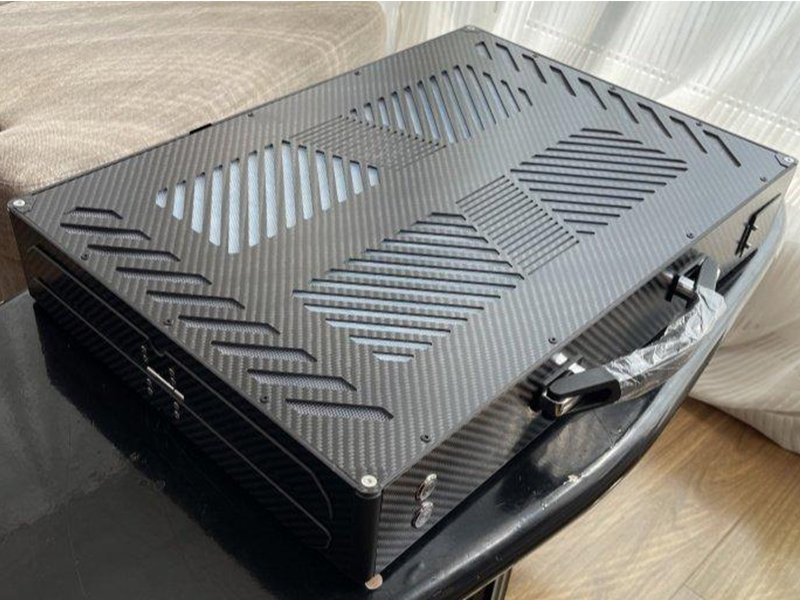
Carbon Fiber Enclosure Design Considerations
The enclosure design needs to match the product’s mechanical requirements, installation conditions, and operating environment. Factors such as fiber orientation, wall thickness, fastening methods, openings, and sealing design all influence the final performance and reliability of the enclosure.
Structural Design and Fiber Orientation
The structural performance of a carbon fiber enclosure depends greatly on how the carbon fiber layers are arranged. Unlike isotropic materials such as aluminum, carbon fiber provides the highest strength along the fiber direction, so the laminate structure needs to be designed according to the expected loads. During the design process, engineers should evaluate the forces applied to the enclosure, including vibration, impact, and mechanical stress. Proper fiber orientation helps improve stiffness and strength while avoiding unnecessary material usage and weight increase.
Wall Thickness and Reinforcement Areas
The wall thickness of a carbon fiber enclosure should be optimized based on the required strength, product size, and manufacturing method. Excessive thickness can increase cost and weight, while insufficient thickness may affect structural stability. Special attention should be given to areas with concentrated stress, such as mounting points, screw holes, connector openings, and load-bearing sections. These areas may require additional carbon fiber layers or local reinforcement to improve durability and prevent cracking during assembly or operation.
Mounting and Fastening Design
The fastening design of a carbon fiber enclosure requires careful consideration because carbon fiber composites have different mechanical characteristics compared with metal or plastic materials. Depending on the application, designers may use embedded metal inserts, bonded fasteners, or external mounting brackets to achieve reliable connections.
Openings and Machined Features
Most carbon fiber enclosures require openings for connectors, switches, ventilation, wiring, or internal component access. The position and size of openings should be evaluated to reduce stress concentration. Additional reinforcement may be required around high-load areas, while CNC machining processes must be properly controlled to achieve accurate dimensions without damaging the carbon fiber layers.
Sealing and Environmental Protection
The enclosure structure must work together with sealing components to protect internal components from moisture, dust, and other environmental factors. Designers should consider factors such as gasket placement, joint structure, assembly tolerance, and required protection ratings. A well-designed sealing system improves the reliability of the enclosure in long-term operation.
Thermal and Electrical Design
Because carbon fiber can conduct electricity, it may provide advantages for electromagnetic interference (EMI) shielding but may also require additional insulation depending on the product requirements. For electronic equipment, designers need to evaluate heat dissipation paths, internal component layout, grounding methods, and electrical isolation requirements.
Carbon Fiber Enclosure Manufacturing Methods
Compression Molding
Compression molding uses carbon fiber prepreg materials placed into a mold and cured under controlled pressure and temperature. This process has good repeatability, high production efficiency, and consistent quality. It is suitable for medium and high-volume production.
Autoclave Molding
Autoclave molding uses high temperature and pressure curing to achieve excellent mechanical properties. It is commonly used for aerospace components, high-performance equipment, and motorsport applications.
Resin Transfer Molding (RTM)
RTM injects resin into a fiber structure inside a mold. This process can handle complex geometry, provide good surface quality, and offer suitable production efficiency.
CNC Machining
CNC machining is commonly used for prototype carbon fiber parts, secondary processing, and precision openings.
How to Choose a Carbon Fiber Enclosure?
A carbon fiber enclosure is not suitable for every product. The choice should be based on the product’s weight, strength, operating environment, production volume, and cost requirements.
Choose a Carbon Fiber Enclosure When:
- Low weight is important. Suitable for drones, portable equipment, robotics, and other weight-sensitive products.
- High stiffness is required. Suitable for equipment exposed to vibration or mechanical loads.
- Corrosion resistance is needed. Suitable for outdoor, marine, and industrial environments.
- Dimensional stability matters. Useful for precision equipment that requires stable enclosure dimensions.
- A premium appearance is required. Suitable for high-end electronics, automotive, and motorsport products.
- EMI shielding is needed. Carbon fiber’s electrical conductivity can support certain shielding applications when properly designed.
Consider Other Materials When:
- Low cost is the main priority. Plastic or metal may be more economical.
- Production volume is very high. Injection-molded plastic may provide lower unit costs.
- Standard plastic provides enough strength. Carbon fiber may add unnecessary cost.
- Electrical insulation is required. Conventional plastics may be more suitable.
- Carbon fiber’s performance advantages are not necessary. A simpler material may provide a more practical solution.
For larger equipment housings where cost and manufacturability are more important than extreme weight reduction, large plastic enclosures can be a practical alternative.
Flexiparts Custom Carbon Fiber Enclosure Manufacturing
Flexiparts supplies custom carbon fiber enclosures tailored to specific mechanical, environmental, and electrical requirements. The service covers design consultation, ply optimization, tooling, molding, precision machining, insert installation, surface treatment, and final assembly.
Contact us to get reliable production results for custom applications.