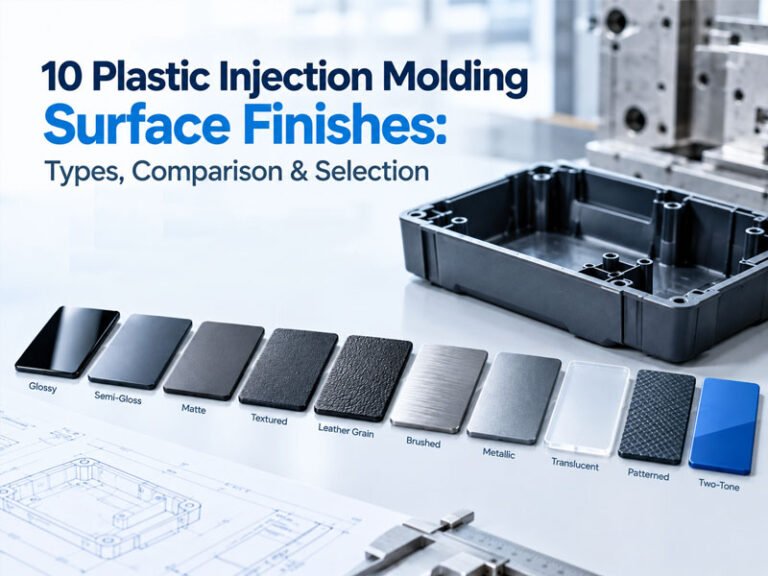
The surface finish of an injection molded part affects its appearance, durability, and cost. Different processes offer different effects, from colors and textures to metallic finishes, printed graphics, and permanent markings.
This guide compares 10 common plastic surface finishes to help you understand their advantages, limitations, and suitable applications.
1. Spray Painting
Paint is atomized through a spray gun and applied to the molded plastic part, then dried and cured to form a coating. Spray painting can create high-gloss, matte, metallic, and soft-touch finishes.
Advantages
- The highest flexibility for color selection, including any Pantone color.
- Can cover injection molding defects such as sink marks and flow marks.
- Surface texture and touch feel can be customized.
Disadvantages
- Higher per-part processing cost.
- The coating may peel or wear off, so a cross-cut adhesion test is recommended.
- PP parts usually require flame treatment or another surface treatment before painting.
- Environmental and VOC control requirements may apply.
Applications
Consumer electronics housings, appliance housings, handles, and electric vehicle plastic components.
2. ABS Electroplating
The ABS surface is chemically roughened, followed by copper, nickel, and chromium deposition to create a multi-layer metallic coating with a mirror-like finish.
Advantages
- Strong metallic gloss and high surface hardness.
- Good wear resistance.
- Available in finishes such as bright chrome, matte chrome, and gunmetal black.
Disadvantages
- Mainly suitable for ABS and ABS+PC substrates.
- Requires wastewater treatment.
- Higher processing cost.
- Electroplated parts have limited flexibility and may crack when bent.
- The conductive metal layer can interfere with wireless signals.
Applications
Bathroom fixture trim rings, knobs, automotive decorative trim, and small appliance decorative parts.
3. NCVM Non-Conductive Vacuum Metallization
Metal is deposited inside a vacuum chamber, followed by a dielectric coating. The result provides a metallic appearance while keeping the coating non-continuous and electrically non-conductive.
Advantages
- Provides a metallic appearance without making the part electrically conductive.
- No conventional electroplating wastewater.
- Suitable for areas that need to support wireless charging and wireless communication.
- Can produce semi-transparent effects.
Disadvantages
- The mirror effect is generally weaker than electroplating.
- Coating may become thinner in deep grooves and recessed areas.
- Higher unit cost than standard spray painting.
Applications
Smartphone frames, wearable devices, and Bluetooth device housings.
4. Mold Texturing / Chemical Etching
A texture is chemically etched directly into the mold cavity. The texture is transferred to the plastic part during injection molding, eliminating the need for additional surface processing. Common patterns include VDI textures, leather grain, fine sand texture, and pebble or litchi texture.
Advantages
- No additional per-part finishing cost after molding.
- Permanent and wear-resistant surface texture.
- Can help hide weld lines.
- Improves grip and reduces the visibility of fingerprints.
- Highly economical for high-volume production.
Disadvantages
- Additional mold texturing cost is required during mold manufacturing.
- Changing the texture usually requires re-etching the mold.
- The molded surface generally uses one base color rather than multiple colors.
Applications
Appliance housings, automotive interior components, and tool housings.
5. Sandblasting
Compressed air propels glass beads, aluminum oxide, or other abrasive media onto the molded plastic surface to create a uniform matte finish.
Advantages
- Quickly produces a matte or frosted appearance.
- Reduces the inexpensive appearance of glossy plastic surfaces.
- Suitable for fast prototyping and small-volume production.
- Can cover minor surface imperfections.
Disadvantages
- Edges and corners may receive more abrasive wear.
- Difficult to reach deep holes and internal cavities.
- Fingerprints may become more visible over time.
- Surface consistency is generally lower than mold texturing.
Key Difference
Mold texturing creates the texture directly in the mold, while sandblasting is performed on the molded part after injection molding.
6. Screen Printing and Pad Printing
Screen Printing: Best suited for flat surfaces and large curved surfaces. It is cost-effective for large single-color graphics, while multi-color designs require multiple printing passes.
Pad Printing: A silicone pad transfers ink onto the surface. It is suitable for complex curved surfaces, small buttons, irregular surfaces, and detailed logos or characters.
Advantages
- Suitable for logos, text, symbols, and simple graphics.
- Fast processing for prototypes and small production runs.
Disadvantages
- The ink remains on the surface and may wear or peel after prolonged scratching or use.
- Complex gradients and highly detailed graphics can be difficult to reproduce consistently.
Applications
Button markings, housing logos, and knob markings.
7. Laser Engraving / Laser Marking
A high-energy laser changes the color of the substrate or removes the surface layer to create a permanent mark.
Advantages
- The marking does not peel off like printed ink.
- Very high marking precision.
- Suitable for variable QR codes, serial numbers, and other traceability information.
- No printing consumables are required.
Disadvantages
- The final color depends mainly on the properties of the plastic substrate.
- Custom multi-color graphics are generally not possible with standard laser marking.
- Dark plastics marked to a lighter color, or light plastics marked to a darker color, usually provide the clearest contrast.
Applications
Serial numbers, logos, button backlighting characters, and product identification marks.
8. Hot Stamping
A heated stamping head transfers hot stamping foil onto the plastic surface under heat and pressure. Foils are available in gold, silver, brushed metal, holographic, and other finishes.
Advantages
- Creates a high-end metallic appearance for logos and decorative details.
- Works well for small decorative areas.
- Fast for prototyping and small production runs.
Disadvantages
- Mainly suitable for flat or slightly curved surfaces.
- Difficult to apply to deeply curved surfaces.
- Large-area hot stamping can have lower yield rates.
- The foil layer can be scratched relatively easily.
Applications
Decorative plastic parts for gift boxes, small appliance logos, and decorative metallic borders.
9. Hydro Dipping / Water Transfer Printing
A printed transfer film floats on the surface of water. After activation, the film wraps around complex 3D plastic parts. A protective clear coat is then applied. Common patterns include wood grain, carbon fiber, marble, and camouflage.
Advantages
- Can cover complex three-dimensional surfaces.
- Reproduces natural-looking decorative patterns.
- Can create wood grain and carbon fiber effects that are difficult to achieve with conventional spray painting.
Disadvantages
- Additional per-part processing cost.
- The pattern may stretch or deform around sharp edges and corners.
- Yield control can be more difficult for complex parts.
- A protective clear coat is normally required.
Applications
Electric vehicle housings, automotive interior components, handles, and decorative housings.
10. IMD / IML In-Mold Decoration
A printed PET film is placed into the mold cavity before injection. Molten plastic is then injected directly against the film, creating an integrated part. The ink is sealed between the film and plastic, providing high resistance to wear and fading.
Advantages
- Graphics are integrated into the part and have excellent scratch resistance.
- Suitable for touch panels and semi-transparent display windows.
- Combines decoration and molding into one process, reducing additional finishing steps.
Disadvantages
- Higher mold and tooling costs.
- Film preparation and tooling can require a longer lead time.
- More economical for high-volume production; small production runs can be expensive.
Applications
Rice cooker control panels, washing machine panels, and touch-control appliance panels.
Comparison of 10 Plastic Injection Molding Surface Finishes
| Surface Finish | Best For | Cost | Durability | Curved Surfaces | Color Options | Watch Out For |
|---|---|---|---|---|---|---|
| Spray Painting | Custom colors, soft-touch feel | Medium | Medium | Excellent | Full color range | Paint can peel if adhesion isn’t tested |
| ABS Electroplating | Premium mirror/chrome look | High | Very High | Good | Metallic only | ABS only; conductive |
| NCVM Vacuum Metallization | Satin metallic, no-conductivity needs | High | High | Moderate | Metallic only | No true mirror finish |
| Mold Texturing (Etching) | High-volume parts, no per-unit cost | Very Low* | Very High | Excellent | Single color | Color locked in; tooling cost upfront |
| Sandblasting | Simple matte/frosted look | Low | Medium | Moderate | Single color | Less consistent; edges wear faster |
| Screen/Pad Printing | Logos, small graphics | Low | Medium | Flat or small curves only | Limited | Ink can scratch off |
| Laser Engraving | Permanent marks/serials | Very Low | Very High | Excellent | None (uses base material) | Color depends on substrate |
| Hot Stamping | Metallic foil accents/logos | Medium-Low | Medium | Flat/slight curves only | Metallic foil | Low yield on large areas |
| Hydro Dipping | Wood grain, carbon fiber look | Medium-High | Medium | Excellent (3D shapes) | Complex patterns | Pattern distortion at edges |
| IMD/IML | High-res graphics, durable branding | High | Very High | Good | High-resolution | High tooling cost; needs volume |
*Note: Mold texturing carries no per-unit cost, but requires an upfront mold investment.
Which finish fits your project?
- High volume, lowest unit cost → Mold Texturing or Laser Engraving
- Premium, high-end appearance → ABS Electroplating or IMD/IML
- Curved or complex 3D parts → Spray Painting, Mold Texturing, or Hydro Dipping
- Small batch, limited budget → Sandblasting or Screen/Pad Printing
Conclusion
Each plastic surface finish has different advantages, limitations, and cost considerations. The right option depends on the required appearance, part design, durability, production volume, and budget.
Comparing these factors early can help you select a suitable finishing process and avoid unnecessary manufacturing costs.