In everyday driving, the accelerator pedal and brake pedal feel noticeably different. The accelerator pedal is usually lighter and provides a smoother, more gradual response, while the brake pedal feels firmer and transmits a more direct force. These differences are not accidental. They result from the different functions, load conditions, and safety requirements of each component.
Different Functions Determine Material Selection
Accelerator Pedal for Precise Control and Signal Accuracy
The accelerator pedal controls engine output in combustion vehicles or motor output in electric vehicles. In modern vehicles, it often works with an electronic throttle system or drive-by-wire system. When the driver presses the pedal, a position sensor detects the movement and sends a signal to the vehicle control system. The system then adjusts fuel injection, throttle opening, or electric motor output.
Because the accelerator pedal mainly transmits driver intent rather than carrying extreme mechanical loads, its design priorities include comfort, consistent pedal travel, signal accuracy, low weight, and cost-effective mass production. These requirements make plastic a suitable material for many accelerator pedal components.
Brake Pedal for High Load Transfer and Structural Reliability
A brake pedal transfers the driver’s applied force to the braking system. In conventional hydraulic braking systems, this force is transmitted through mechanical connections to the brake booster and master cylinder.
During emergency braking, the pedal mechanism must withstand substantial loads without excessive deformation. It must also maintain its structural integrity after repeated operation over the vehicle’s service life. Therefore, the brake pedal places greater emphasis on strength, stiffness, durability, and fail-safe behavior. Steel and aluminum alloys are commonly used for brake pedal structures because they can provide the required strength and stiffness.
Why Is the Accelerator Pedal Made of Plastic?
Plastic is widely used in accelerator pedal assemblies because it offers several manufacturing and functional advantages.
Lower Weight Improves Comfort
Plastic has a lower density than steel or aluminum. Using plastic for the accelerator pedal reduces the overall weight of the pedal assembly. This can make the pedal easier to operate and reduce driver fatigue during long-distance driving.
Lower Manufacturing Cost
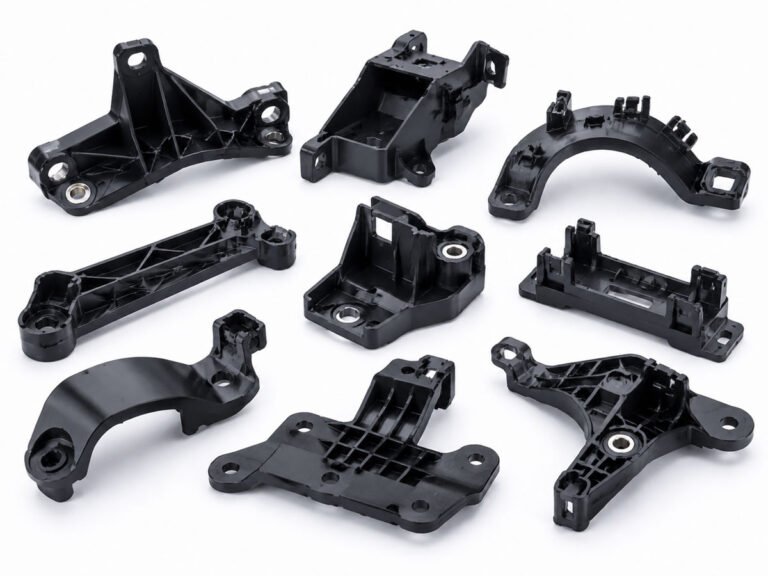
Plastic injection molding is suitable for producing accelerator pedal components in large quantities. A single molding process can integrate several features, such as mounting points, reinforcing ribs, sensor supports, and cable or wiring clips. This can reduce the number of separate components and assembly operations. Once the mold is developed and production parameters are established, injection molding can provide consistent dimensions and efficient mass production.
Electrical Insulation Supports Sensor Integration
Modern accelerator pedals often include electronic position sensors, wiring connectors, and control modules. Plastic provides natural electrical insulation, which helps reduce the risk of electrical interference and short circuits.
This insulation property is particularly useful in vehicles with complex electronic systems. It allows engineers to place sensors and wiring components close to the pedal structure while maintaining electrical separation. Plastic also resists corrosion, which is important for components exposed to humidity, temperature changes, and long-term use.
Design Flexibility and Ergonomics
Injection molding provides flexibility in accelerator pedal design. Manufacturers can produce different shapes, surface textures, and structural features to meet vehicle-specific requirements.
For example, molded plastic components can include:
- Anti-slip surface patterns.
- Rounded edges for foot contact.
- Reinforcing ribs for structural support.
- Integrated mounting and positioning features.
- Different pedal shapes and dimensions.
These features help designers adjust the pedal’s geometry and contact area according to ergonomic requirements.
Why Do Brake Pedals Usually Use Metal?
While plastic is suitable for many accelerator pedal components, the metal brake pedal remains common because braking is a safety-critical function. The brake pedal must transfer substantial force and maintain its shape under repeated high-load conditions.
High Strength and Load-Bearing Capacity
A brake pedal must transfer the driver’s input force to the braking system. Its structure needs to withstand normal operation, emergency braking, and specified abnormal loads.
Steel and aluminum alloys provide suitable mechanical strength for these applications. Metal structures can also be designed with appropriate cross-sections, thicknesses, and reinforcement features to control deformation.
Better Heat Dissipation
Frequent braking generates heat in the braking system. Metal has higher thermal conductivity than plastic, which helps dissipate heat more effectively. Although the pedal itself is not the main heat-generating component, metal construction can support more stable performance in demanding driving conditions.
This property is one reason why metal remains a preferred material for brake pedal arms, brackets, and structural connections. It helps the assembly maintain dimensional stability and mechanical performance over time.
Higher Safety Requirements
Braking directly affects vehicle safety. Therefore, brake pedal components must meet demanding requirements for strength, fatigue resistance, impact resistance, and long-term reliability. Metal structures are well established in these applications and can be validated through established testing methods.
Plastic vs. Metal Pedals: Key Differences
The following table summarizes the main differences between plastic accelerator pedals and metal brake pedals.
| Comparison |
Accelerator Pedal |
Brake Pedal |
| Common materials |
Engineering plastics, sometimes with metal reinforcement |
Steel or aluminum alloy |
| Main function |
Controls engine or motor output |
Transfers force to the braking system |
| Weight |
Lightweight construction preferred |
Strength and stiffness take priority |
| Manufacturing |
Injection molding |
Metal forming, machining, welding, and assembly |
| Cost and production |
Injection molding is efficient for high-volume production |
Metal forming and machining may involve higher processing requirements |
| Mechanical strength |
Must meet operating load requirements |
Requires high load-bearing capacity |
| Electrical insulation |
Useful for sensor housings and supports |
Usually not a primary requirement |
| Design flexibility |
High, with integrated molded features |
Depends on metal forming and assembly processes |
| Main design priority |
Signal accuracy, comfort, and lightweight construction |
Structural strength, fatigue resistance, and safety |
Conclusion
Material selection for automotive pedals must meet functional and safety requirements. As vehicle lightweighting and electrification continue, the use of engineering plastics in automotive components is expanding. However, replacing metal with plastic in safety-related components requires careful evaluation of load capacity, fatigue life, creep, temperature resistance, and long-term durability, followed by appropriate validation. Material substitution must be based on verified performance, not simply weight or cost.
At Jiangzhi, we provide custom plastic injection molding, mold manufacturing, and material selection support for automotive components. Contact us with your drawings or project specifications to discuss your requirements.