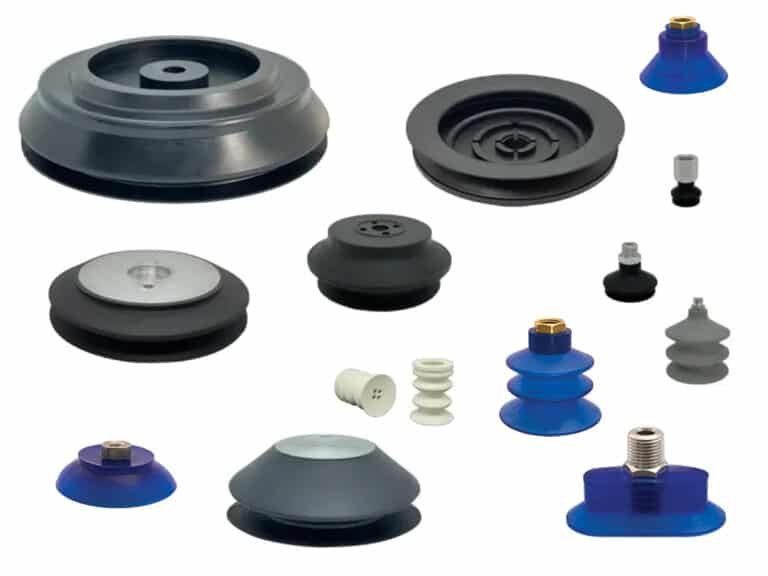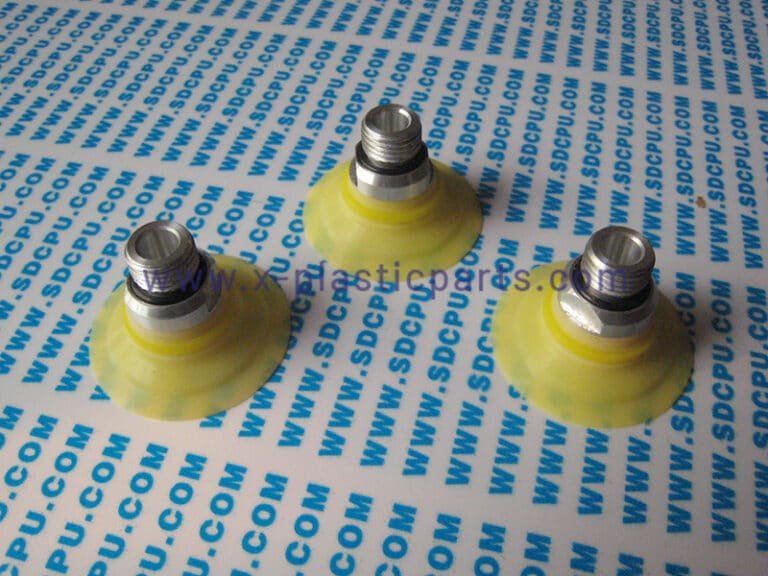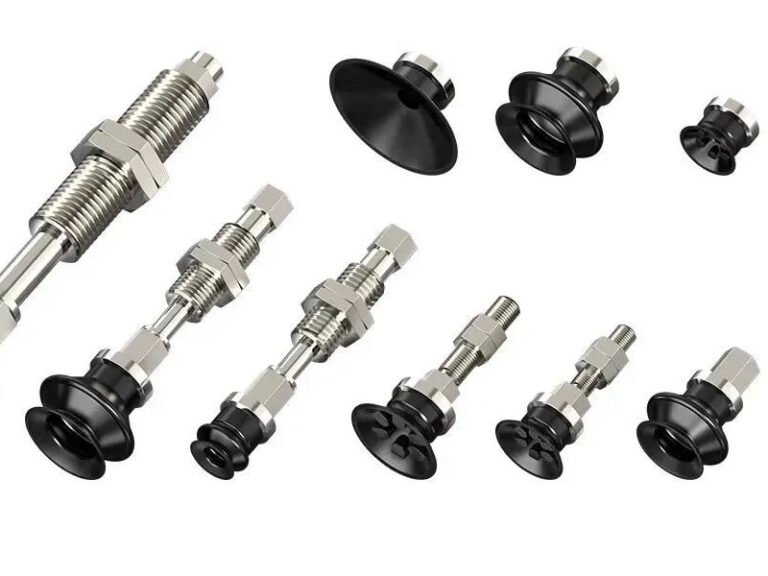
Vacuum suction cups are widely used in automated production lines for pick-and-place, assembly, packaging, and material handling. However, many times, we meet situations like these:
The suction cup is properly installed, but the vacuum gauge never reaches the required vacuum level.
The part is picked successfully but falls during transfer.
Production stops repeatedly because of unstable vacuum performance.
Many users initially suspect the suction cup or vacuum generator and replace components unnecessarily. In reality, most vacuum leaks are caused by a few common installation or system issues.
1. Poor Sealing Between the Suction Cup and the Workpiece
This is the most common cause of vacuum leakage and is often overlooked. Although many people immediately suspect the pneumatic system, the sealing interface between the suction cup and the workpiece is usually the weakest point.
Surface Shape Does Not Match the Suction Cup
Flat suction cups perform best on smooth, flat surfaces. If the workpiece has curved surfaces, raised logos, surface textures, and minor height variations, a flat suction cup may not create an effective seal.
In these cases, a bellows suction cup is often a better choice because it can compensate for small surface irregularities and accommodate approximately 3–5 mm of height variation.
Incorrect Compression Stroke
The suction cup should compress slightly when contacting the workpiece. As a general guideline, the compression should be approximately 10–20% of the suction cup’s free height.
Too little compression will cause insufficient sealing force; too much compression causes cup deformation and vacuum leakage and possibly damage delicate parts.
Aging or Hardened Suction Cups
Silicone suction cups gradually harden after long-term use, especially in environments involving high temperatures, oil contamination, and chemical exposure.
A hardened suction cup loses elasticity and cannot conform well to the workpiece surface.
If the suction cup shows cracks, hardening, or permanent deformation, replace suction cups immediately.
Quick inspection: Press the suction cup gently against the workpiece and check whether the sealing lip contacts the surface evenly without gaps or lifted edges.
2. Air Tubing and Fitting Leaks
The pneumatic circuit is another common source of vacuum loss, particularly after machine installation or maintenance.
Threaded Fittings Are Not Properly Sealed
Threaded pneumatic fittings should be sealed with PTFE thread seal tape. If forgetting to use seal tape or wrap the tape in the wrong direction, wrap the tape clockwise (the same direction as tightening) for approximately 3–5 turns, starting near the thread base before installing the fitting.
Excessive Tube Bending
Sharp bends in pneumatic tubing, especially 4 mm tubing, can restrict airflow, increase pressure loss, and cause cracking over time. Instead of bending the tube sharply, use elbow fittings to create smooth routing.
Push-In Connectors Are Not Fully Inserted
A tube inserted only halfway into a push-in fitting may appear secure but can leak immediately. Always push the tube completely into the fitting until it locks.
A simple check is to pull the tube gently after installation. If it comes out easily, it was not fully seated.
Damaged Air Tubing
Over time, pneumatic tubing may become damaged by abrasion, compression, and repeated machine movement.
Pay special attention to tubing routed near moving components.
3. Incorrect Vacuum Generator Selection or Installation
If the suction cup and air circuit are functioning properly, the vacuum generator should be evaluated.
Vacuum Generator Capacity Is Too Small
Larger suction cups require greater vacuum flow. If the vacuum generator cannot provide sufficient flow, the system may never reach the required vacuum level.
A simple test is to completely block the suction cup port with your finger. If the vacuum gauge reaches the rated vacuum (typically above −80 kPa), the generator is functioning correctly. If it cannot reach the rated value, the generator may be undersized or malfunctioning.
Generator Installed Too Far from the Suction Cup
The longer the vacuum line between the generator and the suction cup, the larger the air volume inside the system.
This results in slower vacuum response, longer cycle times, and reduced production efficiency.
Whenever possible, keep the tubing length between the generator and suction cup within 500 mm.
Unstable Compressed Air Supply
Most ejector-type vacuum generators require a stable compressed air supply between 0.4 MPa and 0.6 MPa.
Low or fluctuating air pressure reduces vacuum generation efficiency and causes inconsistent gripping performance.
Installing a pressure regulator and pressure gauge before the vacuum generator helps maintain stable operating conditions.
Recommended Troubleshooting Procedure
When vacuum leakage occurs, follow these steps in order:
Step 1: Block the suction port and measure the vacuum level.
This determines whether the problem originates from the vacuum generator or elsewhere in the system.
Step 2: Inspect all pneumatic fittings and push-in connectors.
Apply soapy water around each fitting. Bubbling indicates an air leak.
Step 3: Check the suction cup.
Inspect for hardening, cracks, proper compression, and correct suction cup type for the application
Step 4: Inspect the pneumatic tubing.
Look for sharp bends, crushed tubing, abrasion, and cracks.
Following this sequence usually allows the leak source to be identified within a few minutes.
Conclusion
Vacuum leakage may seem like a minor issue, but in high-speed automated production it can reduce cycle efficiency, increase downtime, and even result in damaged products. Most vacuum problems can be avoided through proper suction cup selection, correct installation, and regular inspection of the pneumatic system.
At Flexiparts, we manufacture custom rubber and silicone vacuum suction cups for automation equipment across industries including electronics, automotive, packaging, medical devices, and industrial manufacturing.
If you are developing a new vacuum suction cup project, send us your drawings or application details. Our engineering team can custom the appropriate suction cup material, shape, hardness, and dimensions based on your workpiece material, surface condition, operating environment, and vacuum system requirements.