A wave washer solves a common assembly problem. A bearing that sits loosely in its housing can rattle, wear, and run noisily, and a rigid spacer cannot follow the dimensional changes that come from tolerances and temperature. A wave washer, also called a wave spring washer, applies a controlled axial force in a fraction of the height a coil spring would need. This article explains what a wave washer is, how it works, the main types of wave washers, what they are used for, how they differ from flat and spring lock washers, how to choose one, and when a custom design is worth considering.
What Is a Wave Washer?
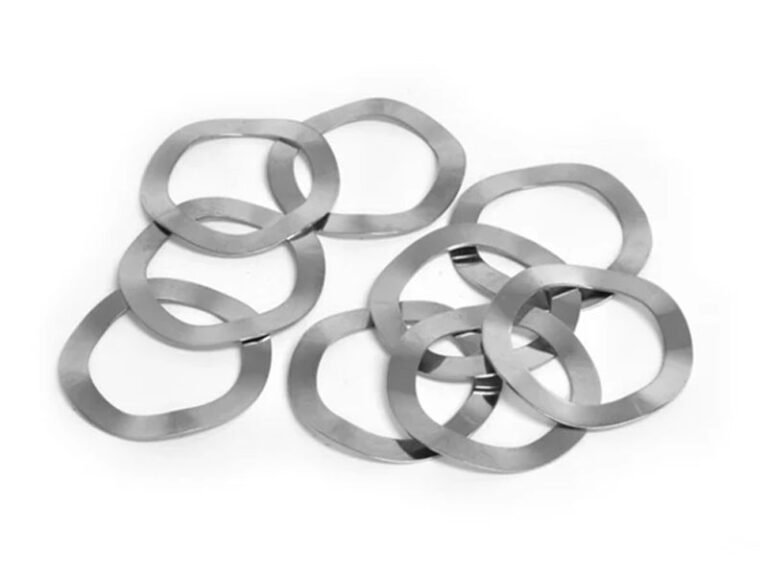
A wave washer is a thin metal ring with a wavy profile. Placed between two surfaces and compressed, its waves flatten and generate an axial force that holds the parts under a steady load. The ring has alternating crests and troughs around its circumference, usually three, four, or six waves, which gives it spring action in very little axial space.
Common structural features include:
- Inner Diameter (ID): Determines whether the washer fits around a shaft or inside a bore.
- Outer Diameter (OD): Determines the radial space required for installation.
- Material Thickness: Influences stiffness and load capacity.
- Free Height: The overall height of the unloaded washer.
- Wave Height and Number of Waves: Affect available deflection and spring characteristics.
Wave washers are commonly used in bearing assemblies, electric motors, automotive components, electronic devices, and industrial machinery where controlled axial force is required in a compact space.
How Does a Wave Washer Work?
A wave washer works by converting axial compression into elastic spring force.
In its free state, the washer has a defined height; the crests rest against one surface and the troughs against the other. When installed between two components, it compresses as the assembly is tightened or loaded. The wavy sections bend and generate a restoring force that pushes against the adjacent surfaces. The force is spread across several evenly spaced contact points, so the load is applied more uniformly around the circumference.
The amount of force depends on the washer’s geometry, material properties, and degree of compression. Material thickness, wave height, and the number of waves all influence its load-deflection characteristics.
Three heights are worth knowing:
- Free Height: the height when the washer is unloaded.
- Working Height: the height after assembly, where the washer supplies the required preload.
- Flat Height: the height when fully compressed. This should be avoided, because a washer pressed flat loses its spring action and can take a permanent set or fatigue over time.
In an assembly, the washer is compressed to its working height and applies a light, steady force to the adjacent parts. If part dimensions vary, wear, or grow with heat, the compression changes with them and contact is maintained, so there is no gap and no overload. In a bearing, the washer loads the outer race axially so the balls stay seated, which reduces noise.
Common Types of Wave Washers
Different wave washer designs provide different combinations of load, deflection, dimensional consistency, and manufacturing cost.
Single-Turn Open Wave Washers
Single-turn open wave washers are formed from flat spring material into a wavy ring with an open gap. They provide axial spring force while requiring relatively little installation space. These wave washers are suitable for many general-purpose assemblies that need light to moderate preload or axial clearance compensation. Their performance depends on the material, thickness, wave geometry, and working height.
Stamped Wave Washers
Stamped wave washers are formed from sheet metal, commonly using a stamping or forming process. They can be designed as closed rings with specified wave profiles. This construction is useful when the application requires a particular ring geometry, dimensional consistency, or efficient repeat production. The achievable tolerances and load characteristics depend on the tooling, material, and manufacturing controls.
Multi-Turn Wave Springs
A wave spring has several turns of flat wire. In the same radial footprint, it offers more deflection and travel than a single-turn washer, but it is taller in the axial direction. Crest-to-crest, nested, and shim-end versions are common. When a single-turn washer cannot provide enough travel, a multi-turn wave spring is the usual alternative.
What Are Wave Washers Used For?
Wave washers are used when an assembly needs axial spring force, clearance compensation, or elastic support within a limited space.
Bearing Preload and Axial Clearance Compensation
In suitable bearing assemblies, a wave washer applies axial force to help maintain the intended bearing position and preload.
It can also compensate for small dimensional variations between assembled components. Especially when manufacturing tolerances or changes in operating temperature affect axial clearance.
Reducing Assembly Noise and Component Rattle
Axial gaps between components can cause movement, vibration, or rattling during operation. A properly selected wave washer maintains contact force and can reduce noise caused by this movement. Common applications include electric motors, small mechanical assemblies, switches, and equipment with moving components.
Providing Elastic Support in Limited Spaces
Wave washers provide spring action where the available axial height is too limited for a conventional coil spring.
They are used in automotive systems, electronic equipment, industrial machinery, and other compact assemblies. Depending on the design, they can help maintain contact pressure, compensate for tolerance variations, or accommodate small changes in component dimensions.
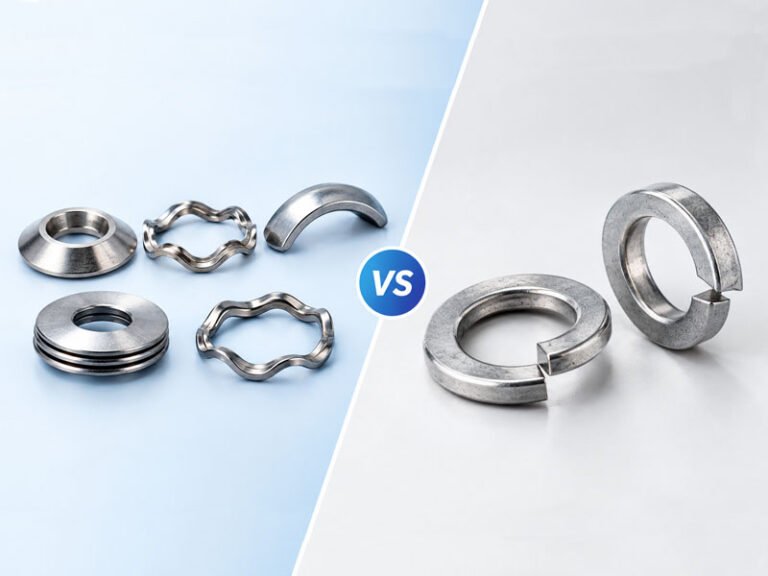
Wave Washer vs. Flat Washer vs. Spring Lock Washer
Although these components look similar, their primary functions differ.
| Feature | Wave Washer | Flat Washer | Spring Lock Washer |
|---|---|---|---|
| Main function | Provides axial spring force | Distributes contact load | Intended to help resist loosening |
| Structure | Wavy ring | Flat ring | Commonly a split, helical ring |
| Elastic function | Designed to generate spring force under compression | Not designed for intentional spring action | Deforms during installation |
| Axial clearance compensation | Suitable within its working range | Not its primary function | Not its primary function |
| Typical application | Preload, spacing, reducing component rattle | Load distribution and surface protection | Selected threaded fastening applications |
| Limitation | Not a locking device; not for high loads | Does not take up clearance | Locking effect is disputed |
How to Choose the Right Wave Washer?
Selecting a wave washer requires more than matching its inner and outer diameters. The washer must fit the assembly and provide the required force throughout its intended operating range.
Check the Available Installation Space
Confirm the inner diameter, outer diameter, free height, and installed height. The inner diameter must fit the shaft or bore, while the outer diameter must clear surrounding components. The free height must also allow enough compression to achieve the required load without exceeding the washer’s intended working range.
Define the Required Axial Load
First, determine the axial force the washer needs to provide at the working height. Consider the required preload, the forces acting on the assembly, and any changes during operation. A washer that fits dimensionally may still be unsuitable if its load is too low or too high.
Determine the Required Deflection
Deflection is the difference between the free height and the installed height. A washer with insufficient available deflection may not accommodate the expected dimensional variation. Excessive compression, on the other hand, can reduce spring effectiveness and increase the risk of permanent deformation. For dynamic applications, also consider how frequently the washer is compressed and released. Repeated loading can affect fatigue life and long-term load stability.
Select the Right Material and Surface Finish
Material selection depends on load requirements, corrosion exposure, operating temperature, and service life.
- Carbon Spring Steel: Suitable for many applications requiring spring properties and mechanical strength. Corrosion protection may be necessary.
- Stainless Steel: Often selected for humid or corrosive environments, depending on the grade and operating conditions.
- Other Spring Alloys: May be considered when temperature, corrosion, or other performance requirements exceed the capabilities of standard materials.
- Surface treatments should be compatible with the base material and application. Consider corrosion resistance, coating thickness, dimensional effects, and any relevant environmental requirements.
When Do You Need a Custom Wave Washer?
Custom wave washers may be necessary when standard products cannot meet specific design requirements.
- Standard sizes do not fit the available space.
- The application needs a specific load at a given working height, with a load tolerance.
- The material must be special, for corrosion, temperature, or electrical reasons.
- A single-turn washer does not give enough travel, and a multi-turn wave spring is needed.
- High-precision assemblies need consistent part-to-part performance.
Conclusion
A wave washer gives controlled preload and clearance compensation in very little axial space. Choosing one means weighing space, working load, deflection, material, environment, and cycle life, keeping it within its working range, and remembering that it is not a locking device.
When standard wave washers do not meet the required dimensions or performance specifications, a custom design may provide a better fit.