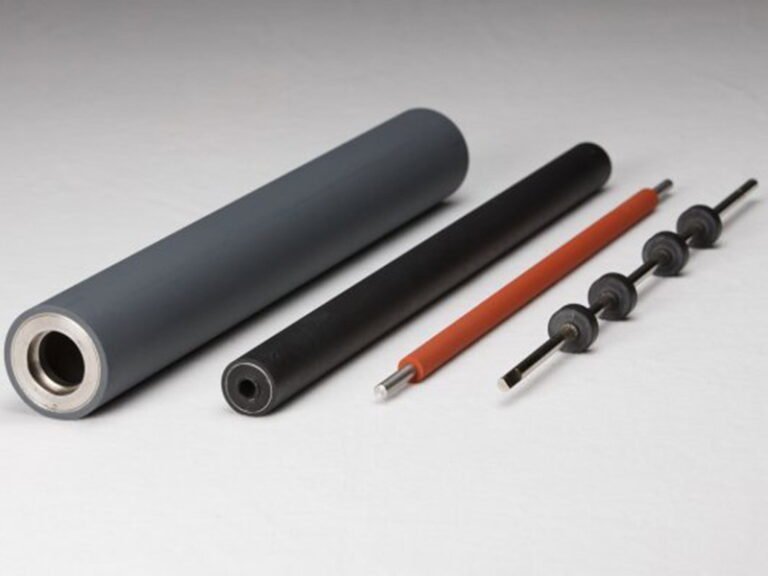
Selecting the right rubber roller hardness is one of the most important decisions when designing or replacing an industrial rubber roller. An unsuitable hardness can cause problems such as uneven pressure, slippage, premature wear, surface marks, and dimensional inconsistencies. These issues are often mistaken for material or equipment defects when the actual cause is an incorrect hardness specification. The rubber roller hardness should be determined during the design stage based on operating load, substrate characteristics, contact pressure, production speed, and expected service life.
What Does Rubber Roller Hardness Really Mean?
Rubber roller hardness is typically measured using the Shore A scale. The Shore A value indicates how much the rubber surface resists indentation under a standardized test. However, in real production, hardness affects much more than a single measurement. A properly selected hardness determines how the roller deforms under load, how quickly it recovers its shape, how consistently it transfers pressure, and how well it resists wear over time.
Increasing hardness generally improves dimensional stability and wear resistance, but reduces the roller’s ability to conform to uneven surfaces. Softer rubber offers better surface contact and cushioning but tends to deform more under pressure.
The selection is always a balance between multiple performance requirements rather than maximizing one property.
| Shore A Range | Surface Deformation | Elastic Recovery | Wear Resistance | Typical Applications |
|---|---|---|---|---|
| 30–40 | High | High | Lower | Delicate materials, cushioning |
| 50–60 | Moderate | Good | Moderate | General conveying, laminating |
| 70–80 | Low | Stable | High | Printing, coating, industrial processing |
| 85–95 | Very Low | High stability | Very High | Heavy-duty conveying, steel processing |
How to Choose Rubber Roller Hardness Based on Your Application
Instead of selecting a hardness based solely on a Shore A number, it is more practical to evaluate the operating conditions first.
When to Choose a Softer Rubber Roller?
Lower Shore A rubber roller hardness is often suitable when the roller needs to conform closely to the material surface.
Typical situations include:
- Uneven or textured substrates
- Delicate materials that can be scratched or crushed
- Applications requiring vibration reduction
- Processes where full surface contact improves performance
Because softer rubber deforms more easily, it distributes pressure more evenly across irregular surfaces. This helps protect fragile materials while maintaining stable contact. Applications may include packaging films, paper handling, textile processing, and other operations involving compliant or sensitive materials.
When to Avoid Soft Rubber Rollers?
Soft rollers are not suitable for every production environment.
They should generally be avoided when:
- Accurate pressure transmission is required
- High-speed production lines demand consistent dimensional stability
- Tight registration or positioning accuracy must be maintained
As production speed increases, excessive roller deformation may change the contact area and pressure distribution. This can reduce positioning accuracy and create inconsistent processing results over long production runs.
When to Choose a Harder Rubber Roller?
Higher Shore A rubber roller hardness is usually preferred when maintaining stable geometry is more important than maximizing surface conformity.
Harder rollers are commonly selected for:
- Heavy mechanical loads
- Abrasive operating environments
- Continuous production with long operating hours
- Applications requiring stable pressure output
Since harder rubber compresses less during operation, the roller maintains a more consistent contact profile. This improves repeatability and reduces dimensional variation in many industrial processes. Harder rollers are widely used in steel processing, industrial laminating, heavy conveying systems, and precision coating equipment.
Rubber Roller Manufacturer
When to Avoid Hard Rubber Rollers?
Although higher hardness improves durability, it also has limitations.
- Hard rubber rollers may not be suitable when:
- Processing delicate or easily damaged substrates
- Transferring fine textures or detailed surface patterns
- Operating in low-temperature environments
A roller with excessive hardness may create localized stress on the workpiece, increasing the risk of scratches, deformation, or poor transfer quality. In cold environments, some rubber compounds also become less flexible, which can reduce impact resistance.
Factors That Affect Rubber Roller Hardness
A Shore A reading provides a useful reference, but it does not capture all the conditions the roller experiences during operation. Several factors can affect the effective hardness of the rubber roller after installation.
Operating Temperature
Rubber properties vary with temperature. Higher temperatures generally reduce the apparent hardness because the rubber becomes more flexible. Lower temperatures have the opposite effect, increasing stiffness and reducing elasticity.
Aging and Service Time
Rubber gradually changes throughout its service life. Exposure to heat, oxygen, ultraviolet light, chemicals, and repeated mechanical loading can increase or decrease hardness depending on the rubber compound. Aging may also reduce elasticity, affecting pressure distribution and overall roller performance.
Rubber Cover Thickness
Rubber cover thickness also influences how the roller behaves under load. Even if two rollers have the same Shore A hardness, a thicker rubber cover generally allows greater overall deformation than a thinner one. Therefore, hardness and cover thickness should be considered together during roller design.
Beyond Standard Shore A: Custom Rubber Roller Hardness
Many industrial rollers are available in standard hardness ranges. However, standard values cannot satisfy every application.
Two production lines may process different materials, operate at different speeds, or apply different loading conditions while using similar equipment. In these situations, selecting the same Shore A hardness may produce very different results.
Custom rubber roller hardness allows the roller to be optimized for the actual operating environment rather than relying on a general-purpose specification. This process often involves selecting the right rubber roller material, compound formulation, and hardness range to match specific operating conditions.
Customization can include:
- Selecting the appropriate Shore A hardness range
- Matching rubber compounds to operating conditions
- Adjusting rubber cover thickness
- Optimizing roller structure for pressure distribution
- Balancing wear resistance with substrate protection
Conclusion
There is no universally correct rubber roller hardness. The appropriate Shore A hardness depends on the operating load, substrate properties, production speed, pressure requirements, and expected service life. A hardness value that performs well in one application may create slippage, excessive wear, or product defects in another.
If you are developing new equipment or replacing an existing rubber roller, Flexiparts can help evaluate your application and recommend a custom rubber roller solution. By matching the rubber material, Shore A hardness, and roller structure to your operating conditions, we help achieve stable performance and consistent production quality.