Choosing a caster isn’t just about checking the load rating and selecting a wheel that fits the equipment. A caster may have enough rated capacity but still be difficult to push, unsuitable for the floor, or unable to withstand the operating environment. Proper caster wheel selection should consider the complete working condition.
1. Define the Operating Conditions First
Before comparing caster models, collect the basic application information. This prevents a common problem: choosing a standard caster first and discovering later that it does not match the equipment.
| Factor | What to Confirm |
|---|---|
| Load | Equipment weight plus maximum load, and whether it’s evenly distributed |
| Floor | Smooth or rough, indoor or outdoor, any protective coating |
| Temperature | Continuous operating range, including ovens or cold storage |
| Chemicals | Exposure to oil, acids, bases, or cleaning agents |
| Speed | Manual push versus powered/towed movement |
| Move Frequency | Trips per day and typical travel distance |
| Certifications | Anti-static, food-grade, or cleanroom requirements |
2. Determine the Required Load Capacity
Load capacity is one of the first specifications to calculate.
A basic calculation is:
Required load per caster = Total working load ÷ Number of casters
The total working load should include the equipment itself, the maximum product or material load, tools, accessories, and other items carried during operation.
For example, if equipment weighs 400 kg and carries a maximum load of 600 kg:
Total working load = 400 + 600 = 1,000 kg
With four casters: 1,000 ÷ 4 = 250 kg per caster
However, 250 kg should not automatically become the selected caster’s rated capacity. Actual loads may not be distributed equally. Uneven floors, starting and stopping, thresholds, impacts, and changes in the center of gravity can increase the load on individual casters.
For many general applications, adding a 20–30% margin is a practical starting point. More demanding applications may require a higher safety factor based on speed, obstacles, impact, and operating conditions.
Load capacity should therefore be evaluated together with the actual movement conditions, not as an isolated number.
3. Choose the Right Wheel Material for Caster Wheels
The wheel material directly affects rolling resistance, noise, floor protection, wear, and load capacity.
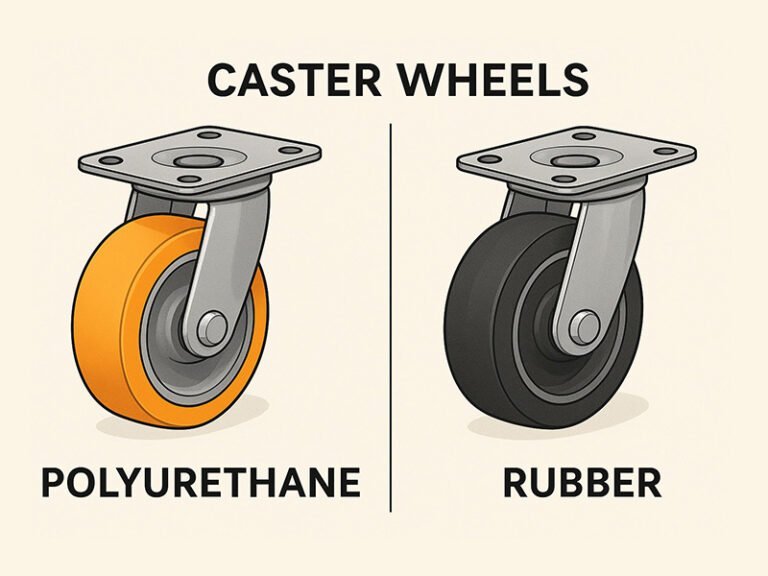
Rubber Caster Wheels
Rubber wheels are useful when quiet operation, shock absorption, and floor protection are important.
They are commonly used on indoor carts, medical equipment, office equipment, and applications where noise needs to be controlled.
However, rubber is not suitable for every heavy-duty application. Temperature, load, chemical exposure, and wear requirements should be checked before selection.
Polyurethane Caster Wheels
Polyurethane is widely used for industrial caster wheels because it provides a useful balance between load capacity, wear resistance, floor protection, and rolling performance.
It can be considered for:
- Factory carts
- Warehouse equipment
- Material handling carts
- Industrial equipment
Compared with very hard wheels, polyurethane can also provide lower noise and better protection for many floors.
Nylon Caster Wheels
Nylon wheels are suitable for hard floors and applications requiring low rolling resistance and good load capacity.
They are commonly used in warehouses, factories, and material handling equipment.
The limitation is that hard nylon wheels can create more noise and may damage sensitive flooring. Floor condition should therefore be considered together with load capacity.
Steel and Cast Iron Caster Wheels
Steel and cast iron wheels are used when very high load capacity and mechanical durability are required.
They can be suitable for heavy machinery and demanding industrial environments.
Their disadvantages include higher noise, greater weight, and a higher risk of floor damage. They are usually not the first choice for finished indoor floors.
4. Consider Caster Wheel Diameter and Rolling Resistance
Caster Wheel diameter has a direct effect on how a caster moves over obstacles. Larger wheels generally pass over thresholds, cracks, floor joints, and small debris more easily than smaller wheels. They can also reduce rolling and starting resistance under comparable conditions.
- Starting resistance is the force needed to get a stationary wheel moving, shaped by diameter, load, floor condition, bearing type, and tread material.
- Rolling resistance is the force needed to keep it moving at a steady pace, caused by the tread compressing and rebounding as it rolls — influenced by the same factors as starting resistance.
- Swivel resistance is separate again: the force needed to change a caster’s direction, driven mainly by tread material, the floor surface, and the offset between the wheel’s center and the swivel axis.
Larger wheels also mean more mounting height, so where clearance is limited, the tradeoff runs the other way — a wider tread or a higher-capacity material can compensate without increasing diameter.
5. Environmental Considerations for Caster Wheel Selection
- Rough or debris-covered floors call for harder materials like iron or nylon; soft wheels wear out or get damaged faster here.
- Outdoor or acidic/alkaline exposure points toward polyurethane, which holds up well against chemicals.
- High heat, above roughly 60°C, rules out standard rubber and polyurethane in favor of phenolic, glass-filled nylon, or metal wheels.
- Cold storage, around -30°C, similarly rules out standard rubber and polyurethane, which stiffen and crack — a cold-rated compound or glass-filled nylon holds up better.
- Noise-sensitive environments like offices or hospitals do better with soft polyurethane or rubber rather than harder materials.
- Coated or precision flooring, such as epoxy floors in food plants, should avoid metal wheels entirely, since they wear through coatings over time.
- Food, medical, or frequently sanitized settings benefit from stainless steel brackets paired with a chemical-resistant wheel material.
6. Choose the Caster Layout for the Required Movement
Caster configuration determines how easily equipment turns and how well it maintains a straight direction.
Four Swivel Casters
Four swivel casters provide good maneuverability and are suitable when the equipment frequently changes direction or operates in a confined space.
The limitation is directional control. Heavier equipment may require more effort to keep moving in a straight line.
Two Swivel + Two Rigid Casters
This is a common configuration for industrial carts.
Two swivel casters provide steering capability, while two rigid casters help maintain straight-line movement.
It is suitable for:
- Factory carts
- Material handling carts
- Warehouse equipment
- Long equipment frames
Four Rigid Casters
Four rigid casters are suitable when the equipment mainly moves in a straight line.
They provide directional stability but offer limited maneuverability.
The best configuration depends on how the equipment is actually pushed, pulled, or powered during operation.
7. Mounting Method and Bearing
The caster must physically match the equipment structure. Common mounting methods include:
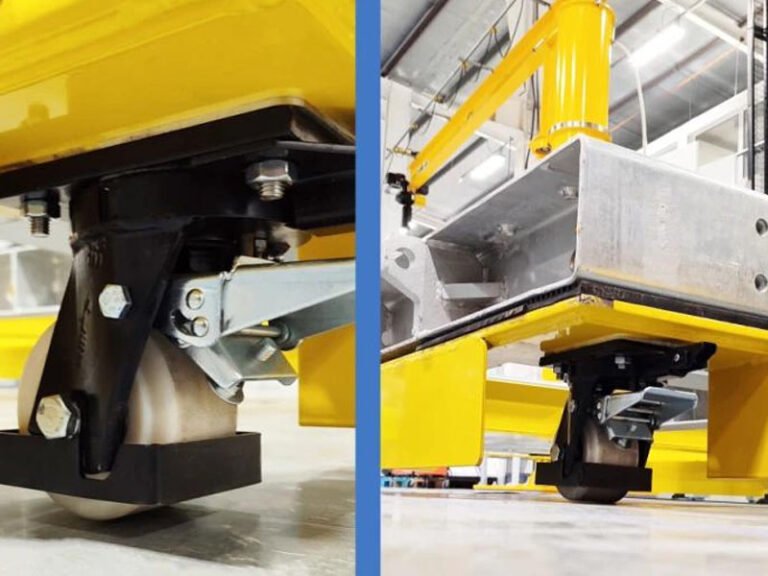
- Top Plate Mounting: Plate mounting bolts a flat plate to the equipment, offering strong, stable support and the most common choice for industrial use.
- Threaded Stem Mounting: Stem mounting inserts a stem into a socket, common on office furniture and light-duty carts, though it puts more structural stress on the mounting point than a plate does.
Check the mounting plate dimensions, hole spacing, bolt size, available height, and strength of the equipment frame. A caster with sufficient rated capacity can still fail if the mounting plate, bolts, or equipment structure cannot handle the applied load.
For bearings, single ball bearings suit light, intermittent use at low cost. Double ball bearings carry more load and swivel more smoothly, fitting medium to heavy, frequent use. Roller bearings handle heavier loads and impact better, common in industrial and commercial transport equipment. Tapered bearings manage both radial and axial loads, reserved for the heaviest, harshest applications.
8. Consider Brakes and Other Options
Additional caster functions should be selected according to how the equipment is used.
Wheel Brake: A wheel brake prevents the wheel from rotating and helps keep the equipment from moving forward or backward.
Total Lock: A total-lock caster can lock both wheel rotation and swivel movement. This is useful when equipment needs to remain stationary during operation.
Directional Lock: A directional lock restricts swivel movement and keeps the caster aligned in a selected direction. It can be useful for long carts or equipment that needs better straight-line control.
Other options may include:
- Thread guards
- Dust covers
- Sealed bearings
- Shock-absorbing casters
- Stainless steel components
- Corrosion-resistant hardware
For environments with hair, fibers, wire, or plastic film, a thread guard can reduce material from wrapping around the wheel or axle.
9. Common Selection Mistakes
- Underestimating load by skipping the safety margin.
- Mismatching wheel material or diameter to the actual floor and environment.
- Overlooking temperature extremes, chemical exposure, or floor coatings.
- Neglecting bearing capacity or brake requirements relative to actual use.
- Choosing a swivel/rigid layout or mounting type that doesn’t match how the equipment actually moves.
These mistakes often cluster together — getting the conditions in section 1 right upfront prevents most of them.
10. When Standard Casters Are Not Suitable
Standard casters are convenient when the application matches an existing specification. However, some equipment requires a customized solution.
Custom caster design may be considered for:
- Non-standard mounting dimensions
- Limited installation space
- Unusual load distribution
- Very high loads
- Special wheel diameters
- High or low temperatures
- Chemical exposure
- Special floor requirements
- Specific brake functions
- Custom wheel materials
Customization does not necessarily mean redesigning the entire caster. The required change may only involve the wheel diameter, wheel material, mounting plate, hole spacing, bearing, axle, offset, brake, or load rating.
Conclusion
Flexiparts supplies custom caster wheel services. For a custom caster wheel selection, providing the equipment drawing, total weight, maximum working load, installation dimensions, floor condition, movement frequency, and operating environment gives the manufacturer the information needed to evaluate the configuration.