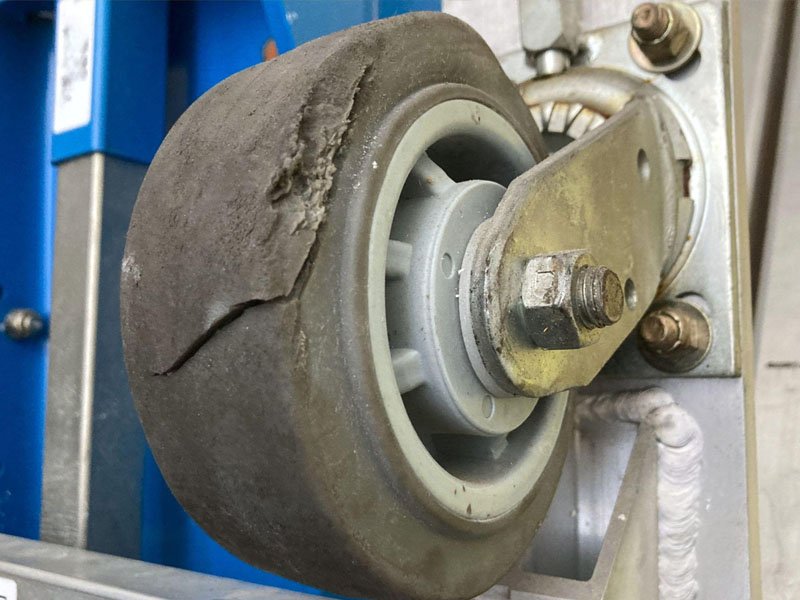
A caster wheel that suddenly gets harder to push, or a wheel that develops a flat spot after sitting under a heavy machine for months, are both signs that the caster wheel load capacity wasn’t matched to the application in the first place. That flat spot isn’t random wear. It happens when a wheel sits under a load above a safe threshold for too long, and the material at the contact point compresses permanently instead of springing back. This article covers what load capacity actually means, how to calculate it, and which factors change it from one wheel to the next.
What Is Load Capacity?
Caster wheel load capacity is the weight a caster is designed to support under specified operating conditions. The rating normally applies to an individual caster, not the complete set of casters.
Load capacity comes in two forms: static load capacity and dynamic load capacity. Static load capacity is the weight a caster can support while the equipment is standing still. Dynamic load capacity is the weight it can support while the equipment is in motion, and it’s typically lower than the static rating, since movement adds shock and momentum on top of the base weight.
How to Estimate Caster Wheel Load Capacity?
The basic calculation starts with the total weight of the equipment and its maximum load.
The starting formula is simple: total weight (equipment plus maximum load) divided by the number of wheels gives the minimum load capacity needed per wheel.
Required Load Capacity per Caster =(Total Equipment Weight + Maximum Load) ÷ Number of Casters
A Safety Margin is Required
That number isn’t the one to shop for, though. Real-world loading is rarely perfectly even. A safety margin needs to be added on top, and there’s a practical reason for it: on an uneven floor, a four-wheeled cart may only have three wheels actually bearing weight at any given moment, with the fourth barely touching down. Uneven weight distribution and sudden stops add further, less predictable load spikes. A safety factor of around 1.3 — adding roughly 30% on top of the base calculation — is a common way to account for this.
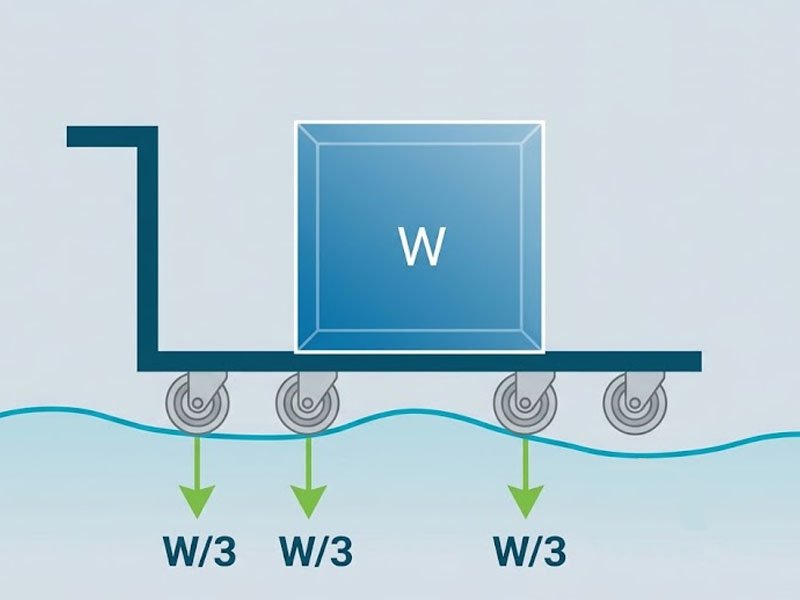
Example. Say a piece of equipment plus its maximum load comes to 800 lbs, mounted on 4 casters. Divide 800 by 4 to get 200 lbs per wheel. Multiply that by the 1.3 safety factor, and the actual target becomes about 260 lbs of rated capacity per wheel — not 200.
Basic Factors That Affect Caster Wheel Load Capacity
The rated capacity of a caster depends on more than the wheel itself. Several design and operating factors need to be considered together.
Wheel Material
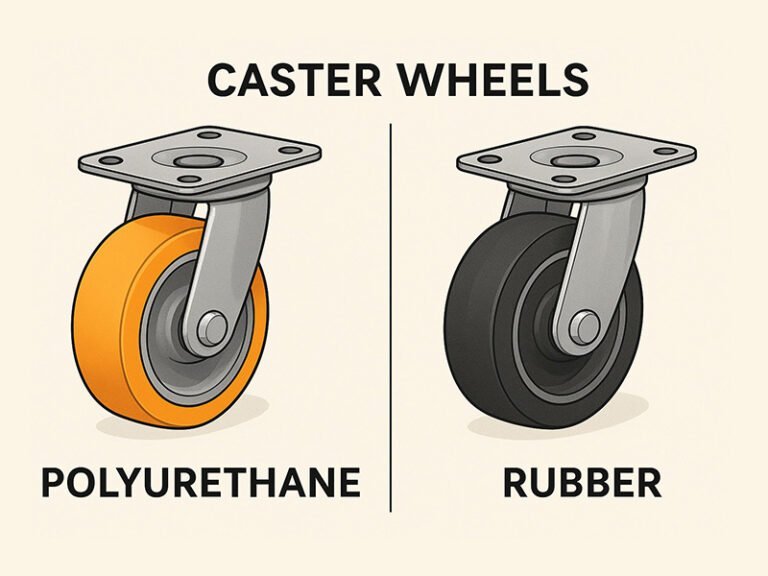
Wheel material affects load capacity, rolling resistance, floor protection, noise, and shock absorption. Common caster wheel material options include rubber, polyurethane, nylon, polyolefin, steel, and cast iron. Rubber wheels can provide good shock absorption and floor protection. Polyurethane offers a balance of durability, load capacity, and floor protection for many industrial applications. Nylon and other hard wheels can provide low rolling resistance on suitable smooth floors, while steel and cast iron are used for demanding heavy-load applications.
Material selection should therefore be based on the load, floor condition, noise requirements, chemical exposure, and operating environment.
Wheel Diameter
Wheel diameter affects both caster weight capacity and mobility. Larger wheels generally move more easily over uneven floors, small obstacles, and thresholds. They can also reduce the effect of floor irregularities during movement.
However, wheel diameter alone does not determine load capacity. Wheel width, material, bearing design, axle size, and caster frame must also be considered.
If a heavy cart is difficult to push, increasing wheel diameter may improve mobility, but the complete caster assembly still needs to meet the required load rating.
Caster Structure and Bearing
The caster frame, axle, mounting plate, stem, and bearing all contribute to the overall load capacity.
A heavy-duty wheel mounted in a lightweight frame does not automatically create a heavy-duty caster.
Bearing selection also affects rolling performance under load. Depending on the design, ball bearings, roller bearings, or plain bearings may be used.
Operating Environment
Floor condition, temperature, and exposure to chemicals all affect how a wheel performs in practice, not just its rated capacity on paper. A wheel rated for a certain load on a smooth warehouse floor won’t necessarily perform the same way outdoors or on a rough surface.
Extended Static Loading
This is the factor behind the flat-spot problem mentioned earlier. When equipment sits in one place for a long time, the actual load should generally stay within 50% to 60% of a wheel’s rated capacity, depending on the material — soft rubber wheels are more susceptible to this than polyurethane. Staying within that range prevents the wheel from deforming permanently at the contact point.
Common Caster Wheel Load Capacity Levels
These ranges are general industry references rather than fixed standards, since exact figures vary by manufacturer and wheel construction.
- Light duty generally covers roughly 10 lbs up to around 150–250 lbs per wheel. The bracket is typically thin stamped steel, around 2–4mm thick, paired with a small wheel diameter of 2 to 4 inches and wheel materials like polypropylene, nylon, or soft rubber. A simple single-ball-bearing raceway is common rather than anything more robust. Light-duty caster wheels suit office furniture and light carts.
- Medium duty typically runs from around 150 lbs up to roughly 800–1,000 lbs per wheel. Construction steps up to a double-ball-bearing swivel raceway for smoother, more durable rolling, with wheel diameters usually between 3 and 8 inches. Common wheel materials include hard or soft rubber and polyurethane, chosen based on whether floor protection or load capacity matters more for the application. Medium-duty caster wheels are suitable for warehouse trolleys and light industrial equipment.
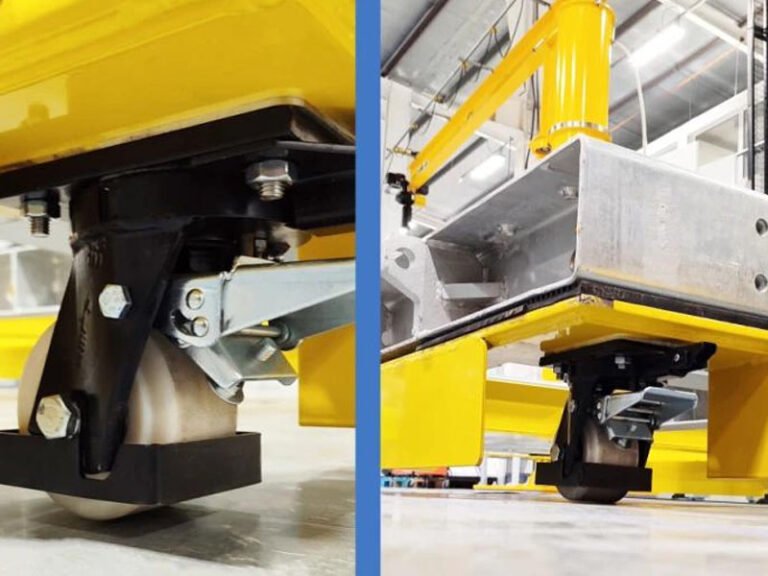
- Heavy duty generally starts above 1,000 lbs per wheel and can extend well beyond that for specialized designs. The housing is thick steel plate, often 8 to 12mm, welded rather than stamped, and the swivel section combines ball bearings with flat thrust bearings to handle both vertical load and side impact. Wheel materials shift toward high-strength polyurethane or nylon bonded to a cast iron or steel core, sometimes forged steel outright. Heavy-duty caster wheels are built for large machinery and heavy industrial applications.
When Do You Need a Custom Caster Load Solution?
Standard casters are suitable for many applications, but some equipment requires a more specific configuration.
Custom caster solutions may be considered when you have:
- Unusually high equipment weight
- Limited installation space
- Special mounting dimensions
- A specific wheel diameter
- Chemical or high-temperature exposure
- Outdoor operating conditions
- Special floor requirements
- High static loads
- Frequent movement with heavy equipment
Conclusion
Caster wheel load capacity isn’t complicated once the basics are in place: know the difference between static and dynamic capacity, run the simple per-wheel formula, add a safety margin for real-world conditions, and account for the material, size, and environmental factors that shift the numbers. If your application falls outside standard ranges or involves unusual conditions, send us your equipment weight, wheel count, and operating environment, and we can help work out the right load capacity solution.