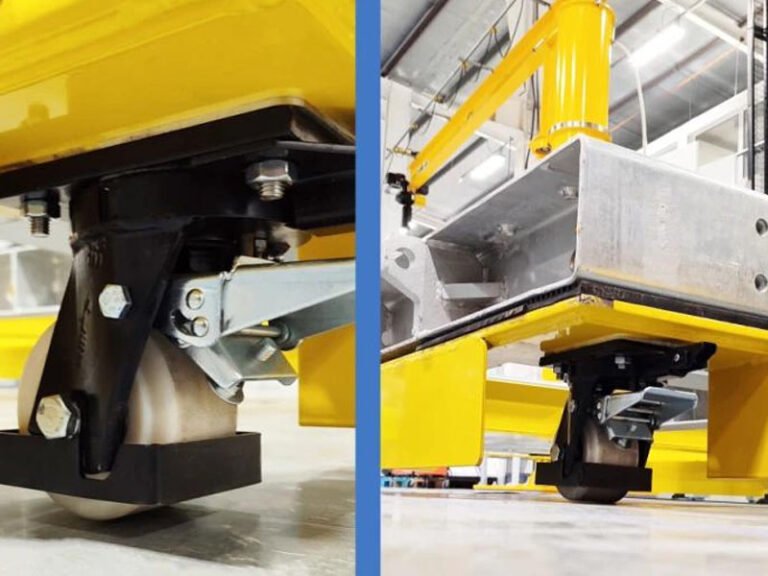
Caster failures can stop equipment movement, increase maintenance costs, damage floors, and create safety risks for operators. In many cases, the failure does not start suddenly. Overloading, incorrect wheel material, unsuitable operating conditions, poor installation, and insufficient maintenance can gradually reduce caster performance. This guide works through the common causes of caster failure in order — what causes it, what it looks like, and how to prevent it — so problems can be caught early or diagnosed quickly after the fact.
1. Load Problems: Overload, Uneven Distribution, and Impact
Overload is the most common cause of caster failure. Many people calculate load capacity by dividing total weight by the number of casters, but this ignores a real-world problem: on uneven floors, a four-wheel piece of equipment may only have three wheels actually bearing weight, with the fourth barely touching down. A more conservative and widely used approach divides total weight by the number of casters minus one, using that result as the minimum rating per wheel.
For example, a 2,000-lb piece of equipment on 4 casters works out to roughly 667 lbs per wheel using this method (2,000 ÷ 3), rather than the less conservative 500 lbs (2,000 ÷ 4).
Impact loading compounds this. The instant a wheel strikes an obstacle or threshold, the force it experiences can be several times its rated capacity. A wheel rated for 100 lbs that hits a bump at 5G momentarily experiences a load equivalent to 500 lbs — this kind of instant spike is often what causes a sudden wheel or bracket failure, rather than gradual wear.
2. Choosing the Wrong Caster Wheel Material
The wrong wheel material can cause premature wear, floor damage, cracking, or loss of rolling performance.
| Wheel Material | Common Failure | Possible Cause | Selection Consideration |
|---|---|---|---|
| PU | Tread wear, chunking, softening | Excessive load, heat, rough floors | Good balance of load capacity, wear resistance, and floor protection |
| Rubber / TPR | Flat spots, wear, cracking | Long static loading, heat, unsuitable environment | Useful for quiet movement and floor protection |
| Nylon | Noise, floor damage, cracking | Hard impact, unsuitable temperature or floor | Suitable for hard floors and higher loads |
| Phenolic | Cracking, edge damage | Impact or rough floors | Useful for some high-temperature applications |
| Metal | Floor damage, noise, deformation | Heavy impact or unsuitable floor | Used for very high-load industrial applications |
3. Temperature, Moisture, and Chemicals
Environmental conditions can cause caster failures even when the load rating is correct.
High and Low Temperature Environment
High temperatures can cause standard rubber and polyurethane to soften, deform, or lose mechanical properties. Heat can also affect bearings and lubricants. High-temperature applications call for phenolic, metal, or specialty high-temp rubber wheels, paired with grease rated for the same range.
Low temperatures can make some rubber and polymer compounds harder or more brittle. Bearing grease may also become more viscous, increasing rolling resistance. Cold environments need a cold-rated wheel compound and a grease formulated to match.
Moisture Environment
Water and humidity mainly create problems for metal components and bearings. Moisture and outdoor exposure let water into unsealed bearings, accelerating internal corrosion and wear, and untreated metal brackets rust — stainless steel or corrosion-treated brackets are the better fit here.
Chemicals Environment
Chemical exposure can cause swelling, softening, cracking, or degradation of wheel materials. Chemical resistance should be evaluated according to the actual conditions, such as chemical type, concentration, temperature, and contact time. A material described generally as chemical-resistant may still have limitations with specific solvents, acids, alkalis, oils, or cleaning agents.
4. Excessive Speed and Bearing Problems
Excessive speed generates friction heat beyond what a caster was designed to handle, accelerating damage to the wheel hub and bearing, and in severe cases causing the wheel material to deform or melt. Manually pushed equipment and powered or towed equipment have very different speed profiles, so actual operating speed — not a generic spec — should drive selection. The operating condition should be evaluated using: Speed + Load + Wheel Material + Operating Time.
Choosing the wrong bearing type for the application is a separate failure path. Single ball bearings suit light, intermittent loads. Double ball bearings carry more weight and swivel more smoothly. Roller bearings handle heavier impact and side loads. Using the wrong type for the actual load and force direction wears the bearing out prematurely.
5. Improper Installation
Correct caster installation is important because even a properly selected caster can fail if it is mounted incorrectly.
Check the Mounting Bolts
Check bolt specifications and mounting surface flatness. Mismatched bolts or stems, or an uneven or burred mounting surface, create uneven stress that accelerates bracket deformation or loosening.
Use the Correct Torque
Incorrect tightening can cause problems in both directions. Too little torque can result in loosening and movement over time. Excessive torque can deform components or affect caster assembly movement.
Recheck After Initial Operation
Newly installed casters, especially on equipment that vibrates or moves frequently, tend to loosen naturally after initial use. A re-torque check around 30 days after installation catches this before it becomes a bigger problem.
Confirm Equal Wheel Height
Make sure all casters are installed at the correct height. If the four casters on a piece of equipment aren’t mounted at equal height, one wheel ends up carrying a disproportionate share of the load.
6. Lack of Regular Maintenance
Many caster problems can be detected before complete failure if the equipment is inspected regularly. For general industrial equipment, a 90-day inspection interval is a good starting point. Here is A 90-Day Checklist.
Spin test. Rotate the wheel by hand and listen for grinding or friction noise. Any unusual sound is a sign to plan for bearing replacement before it seizes completely.
Wobble test. Lift the wheel slightly off the ground and check for axial play. Noticeable wobble means internal bearing clearance is already abnormal.
Push force test. Measure the force required to move the equipment and track it against a baseline. A rising push force is often an early sign of bearing or wheel degradation.
Swivel test. Rotate the swivel section by hand and check for roughness or noise. Roughness usually indicates brinelling — small dents pressed into the bearing race by the balls.
Visual tread inspection. Check for chunking, flat spots, or delamination, and replace before the issue worsens.
Torque verification. Recheck axle nut and bracket bolt torque, especially at the 30-day mark after installation and at least annually afterward.
7. Common Caster Failure Symptoms
A visible failure does not always identify the root cause. Use the symptom as the starting point for inspection.
| Symptom | Possible Cause | Recommended Action |
|---|---|---|
| Flat spot | Long static loading, overload | Check load and wheel material |
| Tread chunking | Impact, rough floor, unsuitable wheel | Check floor and wheel construction |
| Tread delamination | Heat, chemical exposure, bonding failure | Check material and environment |
| Wheel cracking | Overload, impact, temperature | Check load and temperature rating |
| Floor marking | Unsuitable wheel material or excessive load | Review wheel material and load |
| Unusual noise | Bearing or swivel wear | Inspect bearing and raceway |
| Increased pushing force | Bearing wear, flat spot, overload | Check wheel and bearing |
| Swivel binding | Contamination, damage, installation problem | Inspect and clean swivel assembly |
| Loose caster | Fastener loosening or mounting damage | Check mounting and torque |
8. When Should You Replace a Caster?
Whether to replace one wheel or the full set. If multiple casters on the same piece of equipment were installed together under identical conditions and one shows clear failure — not an isolated impact — replacing the full set is usually the better call. Mixing old and new casters creates uneven load distribution, which accelerates wear on the remaining originals.
Don’t just swap in the same part — find the cause first. Replacing with the same spec and material without diagnosing why it failed usually means a repeat failure on a similar timeline.
When it’s worth considering a custom solution. If a standard wheel keeps failing the same way under the same conditions, that’s usually a sign the standard part doesn’t actually fit the application — non-standard load, unusual temperature, or specific chemical exposure. At that point, a custom wheel is a better investment than repeatedly replacing a part that’s destined to fail again.
Conclusion
Most caster failures are related to a combination of conditions. If a standard caster keeps failing on the same equipment, send us the weight, operating environment, and the failure pattern you’re seeing, and we can help identify the root cause and evaluate whether a custom solution makes sense.
FAQ About Casters Failure
Not always. If the other casters are relatively new and show little wear, replacing one may be sufficient. If all casters have similar wear or different rolling performance, replacing the complete set may be more appropriate. First, identify why the original caster failed.