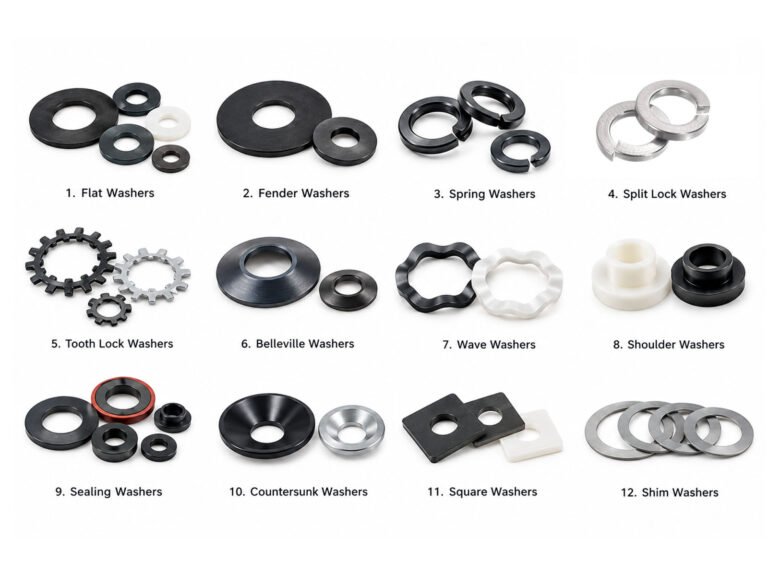
In electronic assemblies and precision mechanical hardware, threaded metal fasteners can conduct electrical currents, transfer thermal energy, and damage delicate substrates. To resolve these challenges, you can utilize specialized non-metallic fasteners known as shoulder washers.
What is a Shoulder Washer?
A shoulder washer is a composite fastening component that integrates a flat outer ring with an extended cylindrical sleeve or neck.
Shoulder Washer vs. Regular Flat Washer
The main difference is their structure and function.
A flat washer is a flat ring placed under a fastener. It helps distribute the clamping load, protect the contact surface, or provide a small amount of spacing.
Shoulder washers provide three-dimensional positioning. The flat flange sits on the outer substrate surface, while the hollow cylindrical shoulder extends directly into the mounting clearance hole. This dual-geometry design enables simultaneous load spreading and hole-wall isolation.
The Three Main Structural Features of a Shoulder Washer
The Flange (Flat Section): Spreads the axial clamping torque over a larger surface area to prevent substrate crushing.
The Shoulder (Sleeve/Bushing Section): The raised cylindrical section helps position the washer, fits inside the panel aperture, forming a protective radial barrier between the fastener shank and the hole wall.
The Center Clearance Hole: Extends continuously through both the flange and sleeve, allowing screws, bolts, or shafts to pass through smoothly.
Common Shoulder Washer Types
Shoulder washer types can be classified by their structure, material, or intended function.
Standard Shoulder Washer: Standard shoulder washers are used for general positioning, spacing, and separation. Their dimensions are selected according to the fastener and mounting hole.
Insulation Shoulder Washer: Insulating shoulder washers separate conductive fasteners from metal housings or other electrical components. They are commonly made from plastic materials with suitable dielectric properties.
Flanged Shoulder Washer: Flanged shoulder washers have a wider flange that provides a larger contact area. This design can help protect the mounting surface and distribute contact pressure.
Plastic Shoulder Washer: Plastic shoulder washers are widely used where electrical insulation, corrosion resistance, or reduced contact damage is required. Available materials include nylon, POM, polycarbonate, and other engineering plastics.
Insulating Sleeve Washers: It is a specialized shoulder washer designed with extra-long sleeves; these components accommodate thick panel walls, multi-layer printed circuit board (PCB) stacks, or deep chassis pass-through holes.
High-Temperature Shoulder Washers: Fabricated from advanced engineering polymers like glass-filled Polyphenylene Sulfide (PPS) or Polyether Ether Ketone (PEEK), these washers withstand continuous operating temperatures above 200°C and meet UL94 V-0 flame-retardant standards.
Heavy-Duty Flanged Washers: Featuring increased flange thickness and higher compressive strength, these components resist radial forces in dynamic mechanical hinges and rotating shafts.
Custom Shoulder Washer: Custom shoulder washers are manufactured to meet specific dimensional and performance requirements. Customization may include the inner diameter, shoulder diameter, flange diameter, shoulder height, thickness, material, and color.
Key Engineering Applications of Shoulder Washers
Shoulder washers perform five critical functions in electrical and mechanical hardware designs:
Electrical Insulation: The primary function of plastic shoulder washers is to prevent conductive contact between metal fasteners and PCB traces, heat sinks, or metal housings, eliminating electrical short circuits and galvanic corrosion.
Positioning and Alignment: The cylindrical shoulder can fit into a mounting hole to help maintain the position of a fastener or component. This reduces unwanted movement during assembly and helps keep components aligned.
Surface Protection: The flange acts as a wear barrier beneath the screw head, preventing paint chipping, surface scratching, or cracking on fragile plastic or glass-filled panels during high-torque installation.
Spacing and Separation: The integrated step geometry establishes precise mechanical clearance gaps between stacked circuit boards, structural plates, and heat dissipation fins.
Wear Reduction: Manufactured from self-lubricating materials, shoulder washers act as low-friction sleeve bearings or glides for light rotary shafts, hinges, and sliding assemblies.
How to Choose the Right Shoulder Washer Material
Material selection affects electrical insulation, wear resistance, dimensional stability, chemical compatibility, and service life. The best material depends on the application rather than one property alone.
| Material Grade |
Key Properties |
Typical Applications |
| Nylon 6/6 (PA66) |
Operating temperature range from -40 ℃ to +105℃; Dielectric Strength: 15 – 20kV/mm; Balanced tensile strength with excellent anti-abrasion and self-lubricating properties. |
Nylon shoulder washers are standard in consumer electronics, household appliances, and general electrical panel insulation. |
| PP (Polypropylene) |
Operating temperature range from -20℃ to +90℃; Dielectric Strength: 20 – 25kV/mm; Lightweight with high moisture barrier performance and exceptional fatigue/flexural resistance. |
Battery housing assemblies, chemical fluid containment systems, and low-cost commercial electrical hardware. |
| PC (Polycarbonate) |
Operating temperature range from -40℃ to +120℃; Dielectric Strength: 15 – 18kV/mm; High impact strength and structural rigidity, though susceptible to stress cracking under harsh solvents. |
Transparent optical housings, high-impact electronic display mounts, and protective covers requiring clear visibility. |
| PVC (Polyvinyl Chloride) |
Operating temperature range from -15℃ to +60℃; Dielectric Strength: 14 – 18kV/mm; Cost-effective, rigid material with inherent flame retardancy and resistance to acids and alkalis. |
Plumbing fixtures, outdoor junction boxes, and low-temperature electrical conduit pass-throughs. |
| PTFE (Teflon) |
Operating temperature range from -200℃ to +260℃; Dielectric Strength: 20 – 25kV/mm; Extremely low coefficient of friction and near-total chemical inertness, though prone to cold-flow deformation under sustained load. |
Chemical processing equipment, cryogenic piping systems, and high-frequency RF electronics requiring chemical-resistant plastic shoulder washers. |
| 30% Glass-Filled PPS |
Operating temperature range from -40℃ to +220℃; Dielectric Strength: 18 – 22kV/mm; Exceptional dimensional stability, high stiffness, UL94 V-0 flame rating, and minimal creep under thermal stress. |
Automotive power electronics, industrial heating units, and high-temperature power supply assemblies. |
| PEEK |
Operating temperature range from -50℃ to +250℃; Dielectric Strength: 20 – 24kV/mm; Superior compressive strength, extreme fatigue resistance, and broad chemical tolerance under continuous mechanical loads. |
Aerospace actuators, medical diagnostic devices, and high-stress semiconductor processing equipment. |
| POM (Acetal / Delrin) |
Operating temperature range from -40℃ to +90℃; Dielectric Strength: 18 – 21kV/mm; High mechanical yield strength, low moisture absorption, and excellent dimensional stability for dynamic wear parts. |
Precision mechanical gearboxes, sliding hinge bushings, and dynamic fuel system hardware. |
Engineering Guidelines for Material Selection:
- For General Electrical Isolation & Cost Efficiency: Select nylon shoulder washers or PP/PVC options for reliable dielectric performance at low production costs.
- For High Mechanical Impact & Structural Clarity: Choose Polycarbonate (PC) or POM (Delrin) to resist physical shocks and maintain tight dimensional stability.
- For Extreme Temperatures & Chemical Contact: Opt for high-performance polymers like PPS, PEEK, or PTFE to ensure long-term joint integrity under harsh operating conditions.
How to Measure Shoulder Washer Dimensions?
Correct measurements help ensure that a shoulder washer fits the fastener and mounting hole. Before ordering or custom production, the following key dimensions should be identified.
Inside Diameter (ID): The diameter of the central pass-through hole. This must equal or slightly exceed the major thread diameter of the screw or bolt.
Outside Diameter (OD) of Flange: The total diameter of the top flat ring. This parameter determines the surface area available for axial load distribution.
Flange Thickness: The height of the top ring, which affects support and spacing. This value must be accounted for when calculating total fastener screw thread engagement length.
Shoulder Outside Diameter (ShOD): The outer diameter of the extended sleeve. This dimension must match the clearance hole diameter of the mounting panel or housing.
Shoulder Length (Sleeve Height): The axial length of the extended sleeve. The shoulder length should equal or be slightly less than the panel thickness to ensure full wall isolation without preventing the fastener from properly clamping the joint.
Overall Height: The total height from the bottom of the flange to the top of the shoulder.
When to Choose Custom Injection Molded Shoulder Washers?
Off-the-shelf catalog hardware covers standard ANSI and DIN thread sizes. However, specialized electronic and industrial applications frequently require custom-molded plastic shoulder washers.
Custom manufacturing is recommended when encountering:
- Non-Standard Panel Thicknesses: Applications where off-the-shelf sleeve lengths are either too long (preventing tight clamping) or too short (leaving exposed metal walls).
- Proprietary Geometry: Needs for rectangular flanges, offset clearance holes, dual-sleeve configurations, or integrated retaining clips.
- Specialized Resin Formulations: Requirements for UL94 V-0 self-extinguishing properties, FDA food-contact compliance, specialized color coding, or custom elastomeric shore hardness blends.
- Precision Mechanical Tolerances: High-density electronic devices requiring dimensional consistency within ±0.02mm to fit tight PCB layout envelopes.
Conclusion
Shoulder washers are essential components for electrical insulation, surface protection, and mechanical alignment in precision assemblies. Selecting the correct type and polymer material ensures long-term joint reliability.
Flexiparts delivers precision custom manufacturing solutions for plastic and nylon shoulder washers. Contact our engineering team today to submit your technical drawings (STEP, IGS, or PDF) for a professional Design for Manufacturability (DFM) evaluation and production quote.