Table of Contents

Plastic Gear Material Selection Guide

plastic gear noise

Plastic gears have become essential components in many modern machines and devices. Their application spans consumer electronics, automotive systems, medical devices, and industrial machinery. The choice of plastic gear material affects performance, lifespan, and costs. If the material does not match the application, issues like wear or failure can occur. Selecting the right plastic gear material ensures reliable operation and controls expenses.

Plastic Gear Material Selection Considerations

When choosing plastic material for a gear, match the material to your operating condition rather than picking on strength alone. Prioritize bending and impact strength if the gear carries shock loads or vibration. Prioritize low moisture absorption and dimensional stability if it runs in humid or wet environments. Prioritize heat resistance if it sits near a heat source or operates continuously at high speed. Prioritize chemical resistance if it’s exposed to oils, solvents, or corrosive media. Weigh these against processing ease and cost, since higher-performance materials typically mean higher tooling and processing expense.

types of plastic gears

Common Plastic Gear Materials

Among the most common materials used for plastic gears are polyamide (PA), polyoxymethylene (POM), and polycarbonate (PC). Each has distinct properties and typical uses.

PA (Polyamide)

Polyamide, commonly known as nylon, is a plastic gear material with self-lubricating properties and impact resistance. It performs well in applications subjected to moderate heat and humidity, though its dimensional stability can vary slightly with moisture absorption. For plastic gear applications, PA6 and PA66 are two widely used variants; PA66 offers higher tensile strength and better heat resistance, making it suitable for higher temperatures and larger gears. PA6 suits larger diameter gears with better shock absorption and low friction, but lower wear resistance and stability. Nylon gears are popular in conveyor systems, packaging equipment, and industrial automation, where noise reduction and vibration damping are important.

plastic gear noise

POM (Polyoxymethylene)

POM is a high-strength material commonly used to make gears due to its remarkable stiffness, low friction, and superior dimensional stability. Its low moisture absorption keeps the gear dimensions consistent. The material resists many chemicals, making it ideal for gears employed in harsh environments. Injection-molded gears made from POM often find their use in household appliances, automotive components, and power tools, where durability and quiet operation are priorities.
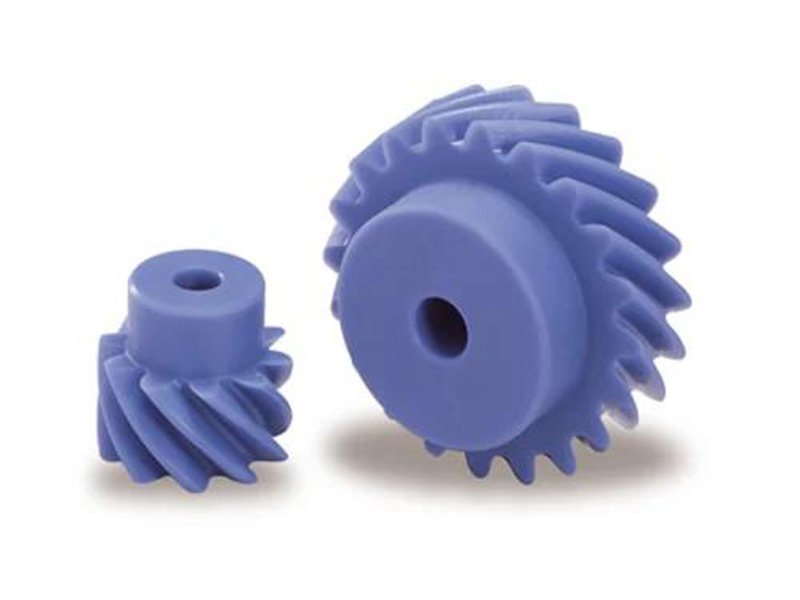
Helical Gears

PC (Polycarbonate)

Polycarbonate is recognized for its excellent impact strength and thermal resistance. PC offers better resistance to high shock loads and is often used for gears exposed to sudden impacts. While not as wear-resistant as nylon or POM, PC’s toughness makes it suitable for gears that require high durability in demanding mechanical systems. Its ability to be injection molded with complex shapes allows for flexible design possibilities.
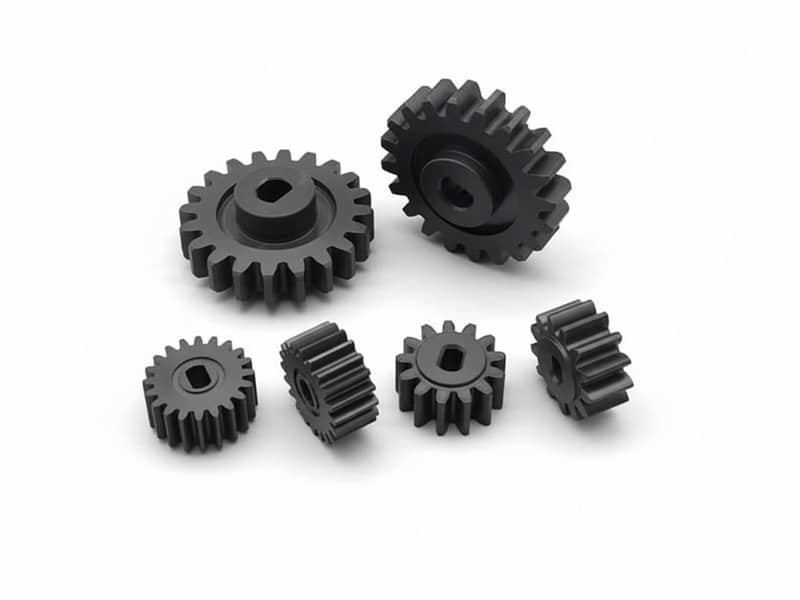
Polycarbonate Gear

Many plastic gear materials can be enhanced through modification to boost specific properties. For example, adding fiberglass or carbon fiber fillers increases the strength, stiffness, and heat resistance of nylon and POM gears. Lubricants can be incorporated to further improve self-lubricating characteristics, reducing wear and extending lifespan. Modified materials fit high-load, high-speed, or high-temperature scenarios. They address base material weaknesses but may raise processing complexity and costs.

Reinforced and Modified Plastic Gears

Many plastic gear materials can be enhanced through modification to boost specific properties. For example, adding fiberglass or carbon fiber fillers increases the strength, stiffness, and heat resistance of nylon and POM gears. Lubricants can be incorporated to further improve self-lubricating characteristics, reducing wear and extending lifespan. Modified materials fit high-load, high-speed, or high-temperature scenarios. They address base material weaknesses but may raise processing complexity and costs.

Other Gear Plastics

Besides PA, POM, and PC, materials such as polyether ether ketone (PEEK), polyphenylene sulfide (PPS), polyimide (PI), and thermoplastic polyesters are occasionally used for specialized plastic gears. PEEK and PI handle sustained high temperatures and demanding mechanical loads; PPS adds strong dimensional stability in humid conditions. These materials offer excellent mechanical properties and chemical resistance, but at a higher cost. While not as common, they are valuable options for high-performance gear solutions in aerospace, medical, and food processing industries.

What is a Pinion Gear

Comparison of Common Plastic Gears

The table compares PA, POM, and PC based on mechanical and chemical properties.
Property Dimension PA POM PC
Bending Strength High, but decreases with humidity Medium, good fatigue resistance High, but prone to stress cracking
Tensile Strength Medium to High High Medium
Wear Resistance Good, self-lubricating Excellent, low friction Lower, needs lubrication
Impact Strength Excellent, absorbs vibration Weak, brittle Good, but low fatigue strength
Heat Resistance Medium (80-120°C) Below 100°C Better (above PA and POM)
Moisture Absorption High, causes size changes Low, stable dimensions Low, stable dimensions
Chemical Resistance Good for organics and alkalis, weak for acids Excellent for organics Good, but corrodes in strong acids
Self-Lubrication Yes Low No
Typical Application Conveyor systems, industrial automation Household appliances, automotive parts High-impact gear systems
Typical Cost Low Medium Medium

Plastic Gears vs. Metal Gears

Compared with metal gears, plastic gears are lighter, resist corrosion, and run quieter thanks to their vibration-dampening properties—making them a common choice when weight, noise, or cost matter more than raw load capacity. For a full breakdown of when to choose plastic over metal (and vice versa), see our plastic vs. metal gear comparison.

How Material Costs Influence Gear Production Choices?

Material costs go beyond the initial purchase. Processing expenses, maintenance, and lifespan affect total outlay. Higher-cost materials may reduce failures and extend use, lowering long-term expenses. Lower-cost options can lead to more replacements if they wear quickly.

  • For PA, low-cost suits high-volume, low-load nylon gears, but high moisture absorption may require drying, adding fees. In humid settings, PA saves upfront but increases repairs from size changes.
  • POM at medium cost offers stability, reducing adjustments, but lubrication adds system expenses. It balances cost and performance in precision uses.
  • PC, also medium cost, provides heat resistance to avoid high-temperature failures, but stress cracking needs modifications, raising processing fees. In hot applications, PC offsets costs through longer life. Choose based on the application to optimize economics.

Conclusion

Choosing the right plastic gear material is fundamental in achieving efficient, durable, and cost-effective gear designs. Flexiparts provides customized plastic gear solutions to meet specific requirements. Contact us and get a solution to meet your application.

FAQ About Plastic Gears

Go with POM or PA6. These are affordable and get the job done.
PA66 or MC Nylon are solid choices, with reinforced Nylon being a great option if you need extra strength.
For precision and durability, try POM, high-rigidity PC, or highly filled Nylon.
Look into PPS, PEEK, or PI. These can handle tough conditions and keep performing.
POM and PPS are your go-to materials for maintaining stability even in humid conditions.
For those needs, consider fiberglass-reinforced plastics or self-lubricating materials, they’ll do the trick!