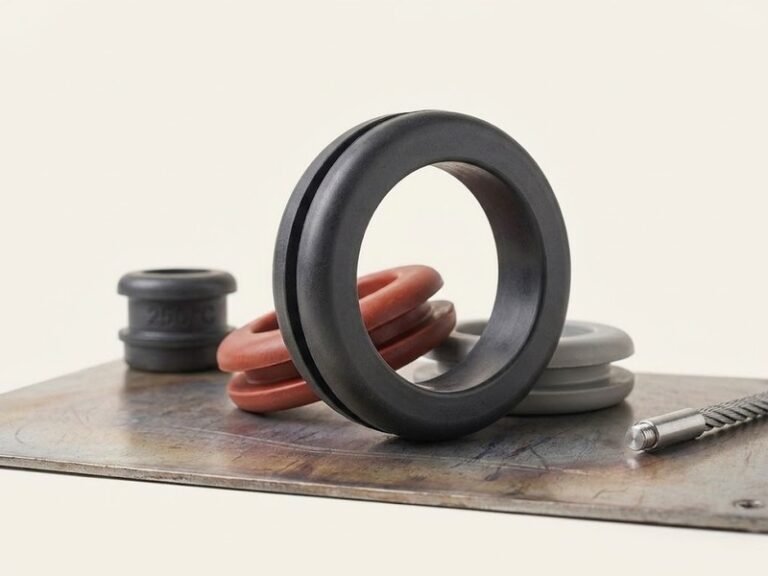
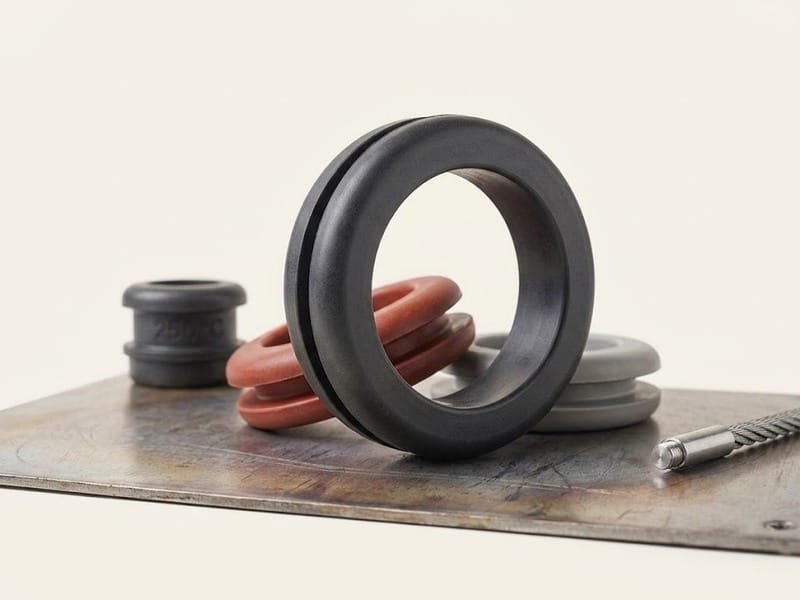
High-temperature rubber grommets provide insulation, sealing, and protection for cables and wires exposed to harsh conditions in a wide range of industrial and automotive applications. If these components can fail in ways that compromise system integrity, leading to equipment downtime, safety hazards, and increased maintenance costs. When standard rubber grommets are exposed to continuous heat, they don’t just degrade—they harden, crack, and lose their sealing force, exposing high-value wiring harnesses to sharp metal edges and fluid ingress. Choosing a heat-resistant grommet is a balance of temperature thresholds, chemical resistance, and tooling precision.
For broader selection guidance, see our complete guide to grommet types and the benefits of rubber grommets for wires.
Why Rubber Grommets Fail in High Temperatures?
Rubber grommets and seals exposed to high temperatures undergo several forms of degradation. These failures develop gradually and often become evident only after equipment has been in service for weeks or months.
Hardening
Hardening occurs when the rubber loses its elasticity due to prolonged thermal exposure. Molecular chains in the polymer begin to crosslink excessively, restricting their natural flexibility. This results in a stiffer, less compliant grommet that cannot conform to irregularities or maintain an effective seal. While a hard grommet may appear intact, it is more brittle and susceptible to subsequent cracking or tearing. In practical terms, a hardened silicone grommet in an engine bay may initially perform its function but eventually fail to cushion vibrations or accommodate thermal expansion, leading to stress on both the grommet and surrounding components.
Cracking
Thermal cracking is another prevalent failure mode. As grommets are exposed to repeated heating and cooling cycles, internal stresses accumulate within the material. Oxygen and other environmental factors, such as UV exposure, can accelerate oxidative degradation. Microcracks develop on the surface, which expand over time. Left unaddressed, these cracks compromise the structural integrity of the grommet, creating pathways for contaminants or exposing wires to mechanical damage. Unlike hardening, which is gradual, cracking can often result in sudden failures, especially in areas with mechanical stress or sharp edges.
Compression Set
Compression set refers to the permanent deformation of rubber after prolonged compression at elevated temperatures. When a grommet is compressed between two rigid surfaces, heat accelerates the loss of its ability to rebound. Over time, the material no longer returns to its original shape, resulting in gaps that compromise sealing and insulation. This mechanism is particularly critical in high-temperature applications where continuous vibration or mechanical load is present, such as in automotive engine compartments or industrial machinery housings.
Cable Damage
Indirect consequences of grommet degradation include cable damage. As grommets harden or crack, their edges may become sharp or abrasive, increasing the risk of cutting or wearing down insulation. Thermal expansion and contraction can exacerbate friction between the grommet and cables, leading to insulation failures or even short circuits. Ensuring proper material selection and maintenance intervals can prevent this cascading failure.
Defining High Temperature
Rubber grommets are rated for continuous operating ranges, but real-world applications often involve peaks that exceed nominal values. Clear ranges guide material selection for heat-resistant rubber grommets.
- <100°C (212°F): This is the standard operational range for general-purpose rubbers. Minimal thermal aging occurs over typical service life.
- 100–150°C (212–302°F): Medium-high temperature applications, such as proximity to heating elements or engine bays. Requires thermally stable elastomers like silicone or EPDM.
- 150–200°C (302–392°F): High-temperature scenarios where exposure is sustained and mechanical stress is present. Materials like Viton (FKM) are recommended.
- >200°C (392°F): Extreme conditions, often requiring specialized fluorosilicone or custom compounded materials.
Notes: Continuous temperature ratings differ from peak temperature exposure. Grommets may survive short-term spikes above their rated temperature but degrade rapidly if such conditions recur frequently. We must account for both average and peak temperatures when designing and choosing rubber grommets.
Best Materials for High Temperature Grommets
Material choice determines the success of heat resistant rubber grommet installations. Different elastomers offer unique combinations of thermal stability, mechanical properties, and chemical resistance.
Silicone Rubber
Silicone rubber offers broad temperature capability, typically from -60°C to +230°C or higher depending on formulation. It maintains flexibility across a wide range, resists hardening, tolerates repeated thermal cycling, and provides excellent electrical insulation. However, it can be less resistant to oils and certain chemicals.
EPDM (Ethylene Propylene Diene Monomer)
EPDM performs well in moderately high temperatures and offers excellent resistance to heat, ozone, and weathering. Its temperature range generally extends up to 150°C (302°F). EPDM is cost-effective and suitable for outdoor or exposed applications, such as cable management on equipment enclosures. Its primary limitation is reduced resistance to oils and hydrocarbons.
Viton / FKM (Fluoroelastomers)
Viton grommets excel in extreme environments with high heat, chemical exposure, and mechanical stress. Operating ranges often exceed 200°C (392°F), and these materials resist swelling and degradation in oils, fuels, and solvents. They are ideal for automotive engine compartments, chemical processing plants, and aerospace applications. The trade-off is higher cost and relatively lower elasticity compared to silicone.
Neoprene
Neoprene offers moderate thermal resistance and good mechanical strength. Its performance typically peaks around 120–150°C (248–302°F). While it provides reasonable resistance to oils and environmental aging, it is generally used in transitional or cost-sensitive applications rather than extreme heat scenarios.