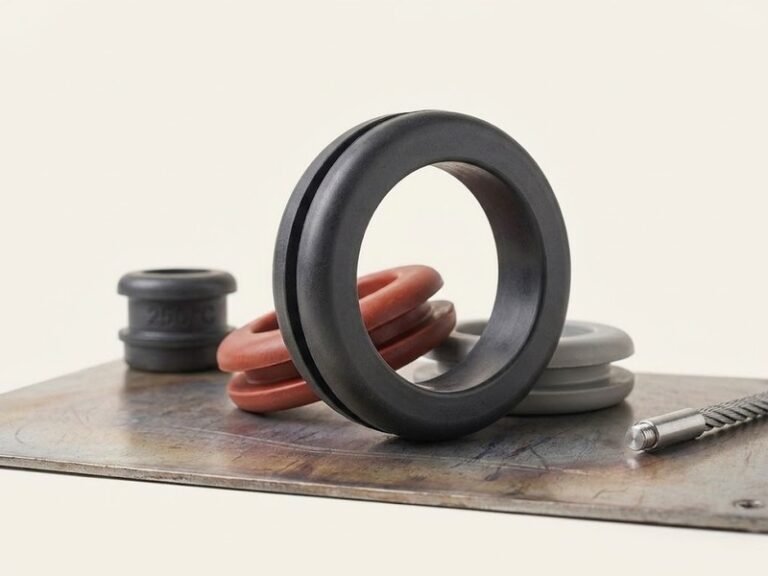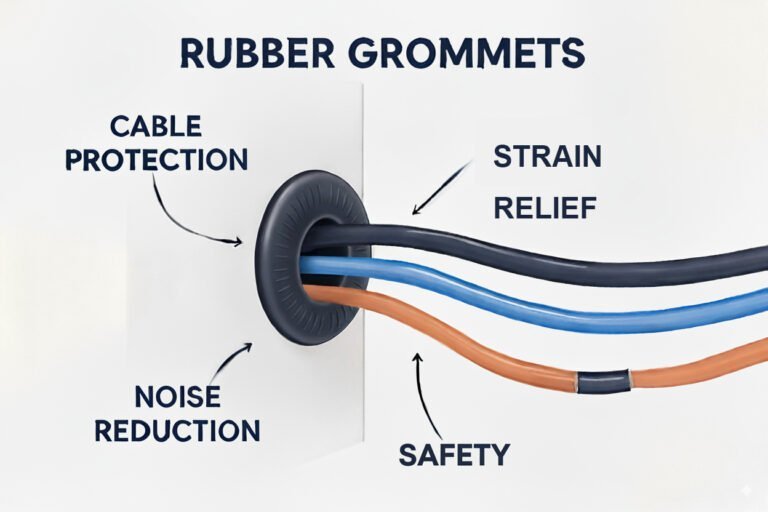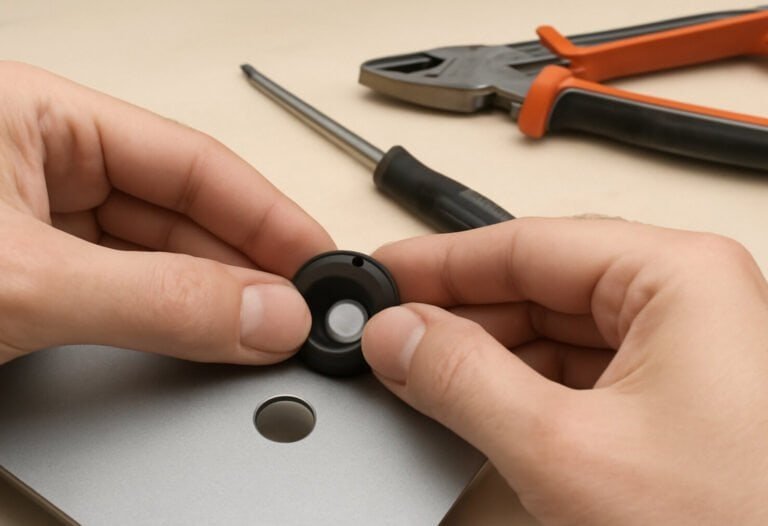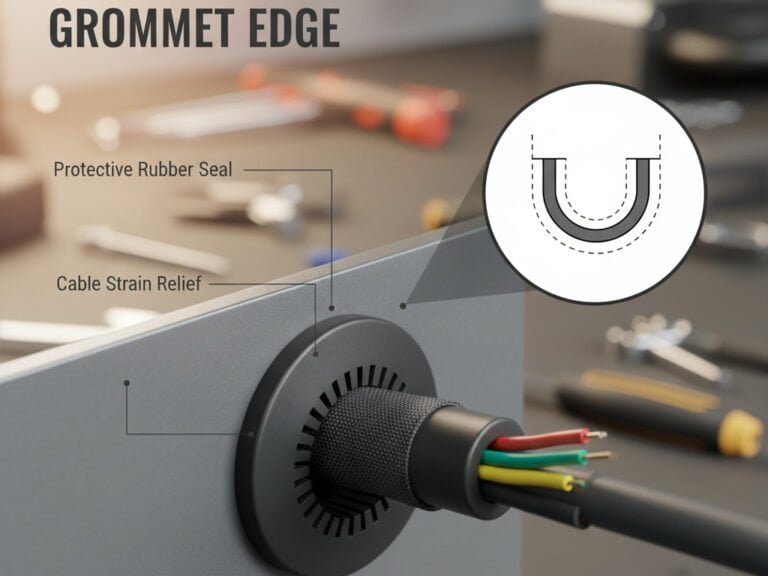
When a cable or wire harness passes through a hole or cut edge in a metal, plastic, or composite panel, that exposed edge is often sharp, burred, or rough. Over time, vibration and movement cause the cable jacket to rub against this edge — leading to insulation wear, exposed conductors, and eventually short circuits or equipment failure. Grommet edging solves this by covering the panel edge with a flexible, protective trim, creating a smooth surface for cables, hoses, and wires to pass through safely.
This guide covers common grommet edging profile types, materials, how to compare them, and how to select the right edging for your application.
What Is Grommet Edging?
Grommet edging is a flexible protective trim installed around sharp panel edges or cutouts. It typically grips onto the edge of the panel (often via a U-shaped channel that wraps around the panel thickness) and presents a soft, rounded surface on both sides — protecting both the panel edge and anything passed through it.
Edging Profile Types Compared
Grommet edging generally comes in three structural designs, each suited to different installation needs:
- U-channel edge trim is a simple U-shaped profile that slides directly over a cut panel edge. It’s straightforward to install and works well on straight or gently curved edges, but it relies on a snug friction fit and can loosen over time on edges with inconsistent thickness.
- Self-grip edging with a metal core embeds a flexible metal strip (often spring steel) inside the polymer profile. This lets installers bend the edging to follow irregular or curved cutouts while the metal core holds its shape and grips the panel firmly — no adhesive needed. This type is generally suited to a wider range of panel thicknesses than plain U-channel trim.
- Molded grommet strips are pre-formed to a specific shape and size, often used where a continuous, finished appearance is required or where the edging needs to integrate with a grommet hole rather than just an edge. These typically require more precise dimensional matching to the panel during design, but offer a cleaner, more consistent fit once installed.
Common Applications of Grommet Edging
- Electrical Control Panels: Sheet metal enclosures often have multiple cutouts for cable entry; edging prevents the panel’s cut edges from cutting into cable jackets during installation and over years of thermal expansion/contraction.
- Automotive Wiring Harnesses: Vehicles subject wiring to constant vibration; edging at body panel pass-throughs helps prevent chafing that could otherwise lead to electrical faults over the vehicle’s service life.
- Telecom Cabinets: Dense cable routing through multiple panel openings benefits from edging that protects bundled cables from sharp metal edges in tightly packed enclosures.
- Generator Boxes: Edging protects wiring harnesses from sharp edges in housings that experience significant vibration during operation.
- HVAC Equipment: Edging is used where wiring or tubing passes through sheet metal panels in units exposed to temperature cycling and outdoor conditions.
- Machinery Enclosures: Edging protects cabling at access points and panel seams in industrial equipment housings.
Common Grommet Edging Materials
The effectiveness of grommet edging depends on selecting the right material, as different materials offer properties suited to specific environments and applications. In most cases, the edging is made from the same material as the grommet, which largely determines its performance.

Silicone
Silicone grommet edging offers excellent flexibility, UV resistance, and high temperature stability. It is suitable for outdoor equipment, food machinery, and high-heat environments.
EPDM (Ethylene Propylene Diene Monomer)
EPDM provides strong weather, ozone, and aging resistance. It is widely used for automotive, outdoor cabinets, and general industrial sealing applications.
PA(Nylon)
Nylon offers high toughness and wear resistance. It is suitable for applications requiring rigid protection and dimensional stability.
PVC (Polyvinyl Chloride)
PVC is an economical material with good abrasion resistance and flame-retardant grades available. It is commonly used for indoor panels and commercial equipment.
Encapsulated Metal Spring Fastening Grommets
These designs combine a spring steel core with a durable polymer coating, typically a thermoplastic elastomer (TPE). This combination provides exceptional edge retention without adhesives, significantly reducing installation time and costs. They offer excellent abrasion resistance, chemical stability, flame, and vibration. They are ideal for aerospace, automotive, telecommunications, and industrial automation.
How to Choose the Right Grommet Edging
1. Panel Thickness – Edging needs to match the sheet metal or panel thickness it will grip. U-channel and self-grip designs typically cover a defined thickness range; if your panel falls outside that range, the edging may either grip too loosely (and slip) or be difficult to install at all. Always check the manufacturer’s thickness range before specifying.
2. Edge Shape – Round holes, straight slots, and irregular cutouts call for different profile types. Straight edges often work well with simple U-channel trim, while curved or irregular cutouts usually need self-grip edging with a metal core that can be bent to follow the contour.
3. Environment – For outdoor or temperature-extreme environments, EPDM, silicone, or metal-core/TPE options generally hold up better over time than standard PVC. For indoor, climate-controlled equipment, PVC is often a cost-effective and adequate choice.
4. Installation Method – Self-grip metal-core edging installs quickly without adhesive and is well suited to production environments where speed matters. Molded strips may require more careful alignment during assembly but can offer a more finished look.
5. Cable Bundle Size – Make sure the edging’s inner opening leaves enough clearance for the cable bundle to pass through and move slightly without rubbing against the edging itself, especially in applications with vibration.
FAQ About Grommet Edging
Q: What is grommet edging used for?
It protects cables, wires, hoses, and tubing from sharp or rough panel edges as they pass through cutouts in metal, plastic, or composite enclosures, preventing abrasion-related failures over time.
Q: What material is best for outdoor use?
EPDM and silicone are the most common choices for outdoor applications due to their resistance to UV, ozone, and a wide range of temperatures. Metal-core/TPE designs are also a strong option where additional mechanical protection is needed.
Q: Does grommet edging need adhesive?
Self-grip designs with a metal or spring-steel core typically do not require adhesive — they grip the panel mechanically. Some molded or strip-style edging may use adhesive backing for additional security, depending on the design.
Q: What’s the difference between grommet edging and a grommet?
A grommet typically refers to a ring-shaped insert that fills and seals a hole, often providing strain relief for a single cable or connector. Grommet edging, by contrast, is a continuous trim that runs along a panel edge or cutout perimeter, primarily protecting against abrasion rather than sealing.
Q: Can grommet edging be used on curved or irregular edges?
Yes — self-grip edging with a flexible metal core can typically be bent by hand to follow curved or irregular cutouts, unlike rigid U-channel trim, which is better suited to straight or gently curved edges.
Q: Is grommet edging available with flame-retardant properties?
Yes. Flame-retardant grades are available in materials such as PVC and certain TPE compounds for applications with specific fire-safety requirements — confirm the relevant flammability rating (such as UL94) with your supplier for your application.
Q: How do I know what size edging I need?
Edging size depends primarily on the panel thickness it needs to grip and the diameter or width of the cutout it will cover. Measuring both accurately — and checking against the manufacturer’s specified thickness range for a given edging profile — is the best way to ensure a secure fit.
Need Custom Grommet Edging?
Flexiparts manufactures custom grommet edging in EPDM, PVC, silicone, and metal-core self-grip profiles. We support custom sizes, colors, hardness, and cut lengths based on your drawings or samples. Contact us today for samples or quotation.