What level of thread fineness qualifies as a fine thread?
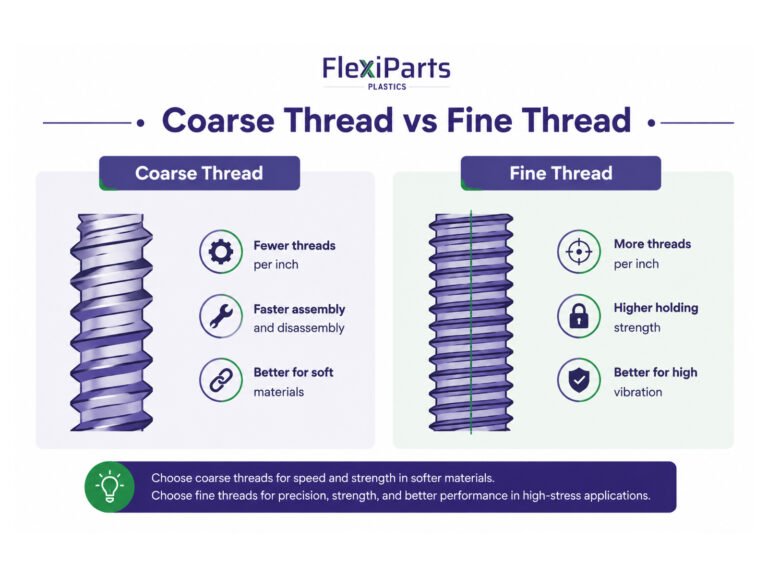
We can define it this way: coarse threads can be regarded as standard threads. Fine threads, on the other hand, are relative to coarse threads. For the same nominal diameter, the number of threads per inch differs, which means the pitch is different. Coarse threads have a larger pitch, while fine threads have a smaller pitch.
For example, in the two specifications 1/2-13 and 1/2-20, the former is a coarse thread, and the latter is a fine thread. They are therefore designated as 1/2-13UNC and 1/2-20UNF.
Since the same nominal diameter can have two different thread types, how should coarse and fine threads be selected?
Coarse Thread
The so-called coarse thread is actually the standard thread. Unless otherwise specified, the stainless steel screws and other fasteners we generally buy are coarse threads.
Characteristics of Coarse Threads: higher strength, good interchangeability, and standard references available. Generally, coarse threads should be the preferred choice.
Compared with fine threads, because the pitch is larger, the thread lead angle is also larger, resulting in poorer self-locking. In vibrating environments, anti-loosening washers or self-locking devices are needed.
Advantages of Coarse Threads: easy to assemble and disassemble, complete range of matching standard parts, easy to interchange.
When marking coarse threads, there is no need to mark the pitch, such as M8, M12-6H, M16-7H, etc. They are mainly used as connecting threads.
Fine Thread
Fine threads are the opposite of coarse threads. They are specified to supplement the special requirements that coarse threads cannot meet. Fine threads also have pitch series; the smaller pitch means better self-locking and anti-loosening performance, more threads, which can reduce leakage and achieve sealing effects.
In some precision applications, fine-thread stainless steel screws are more convenient for precise control and adjustment.
Disadvantages of Fine Thread: lower tensile strength and overall strength compared to coarse threads, threads are easily damaged, not recommended for frequent disassembly. Matching nuts and other fasteners must be equally precise; even slight dimensional errors can damage both the screw and nut.
Mainly used in metric pipe fittings for hydraulic systems, mechanical transmission parts, thin-walled parts with insufficient strength, internal parts with space constraints, and shafts requiring high self-locking.
When marking fine threads, the pitch must be indicated to distinguish them from coarse threads.
Here is a thread Standard Pitch Table:
| Metric Size | Coarse Pitch (mm) | Fine Pitch (mm) | Screw Size No. / 1/4″ | Major Diameter (in) | Major Diameter (mm) | UNC (TPI) | UNF (TPI) |
|---|---|---|---|---|---|---|---|
| M1 | 0.25 | 0.20 | #0 | 0.060 | 1.524 | — | 80 |
| M1.2 | 0.25 | 0.20 | #1 | 0.073 | 1.854 | 64 | 72 |
| M1.6 | 0.35 | 0.20 | #2 | 0.086 | 2.184 | 56 | 64 |
| M2 | 0.40 | 0.25 | #3 | 0.099 | 2.515 | 48 | 56 |
| M2.5 | 0.45 | 0.35 | #4 | 0.112 | 2.845 | 40 | 48 |
| M3 | 0.50 | 0.35 | #5 | 0.125 | 3.175 | 40 | 44 |
| M4 | 0.70 | 0.50 | #6 | 0.138 | 3.505 | 32 | 40 |
| M5 | 0.80 | 0.50 | #8 | 0.164 | 4.166 | 32 | 36 |
| M6 | 1.00 | 0.75 | #10 | 0.190 | 4.826 | 24 | 32 |
| M8 | 1.25 | 1.00 | #12 | 0.216 | 5.486 | 24 | 28 |
| M10 | 1.50 | 1.25 | 1/4″ | 0.250 | 6.350 | 20 | 28 |
| M12 | 1.75 | 1.25 | 5/16″ | 0.3125 | 7.938 | 18 | 24 |
How to Choose Between Coarse and Fine Threads
Thread selection should always be based on functional requirements, assembly conditions, and maintenance expectations.
1. Use Coarse Threads by Default
Choose coarse threads for general fastening applications. They provide better assembly tolerance, higher resistance to damage, and more stable performance under manual or variable-torque assembly.
2. Use Fine Threads Only for Specific Needs
Opt for fine threads when your application involves:
- High Vibration: Environments requiring robust anti-loosening.
- Precision Adjustment: Fine-tuning mechanical positions.
- Fluid Sealing: Leakage-sensitive connections or thin-walled pipe fittings.
3. Match Materials and Control Torque
- Avoid fine threads in low-strength materials (like aluminum or plastics) or shallow engagement depths, as they strip easily.
- If fine threads must be used in thin-walled structures, strictly control the tightening torque to prevent stripping.
- Ensure tight tolerance compatibility between the mating screw and nut; minor dimensional errors will ruin fine threads quickly.