An O-Ring might look like nothing more than a small rubber ring, but it’s often the most critical component in an entire sealing system. Get it right, and it can last for years without issues. Get it wrong, and you’ll face leaks, deformation, or premature failure—problems that end up costing far more than the part itself.
Whether you’re an engineer, a procurement specialist, or a product manager new to custom O-Ring orders, this guide will help you quickly understand the essential parameters for O-Ring design, common pitfalls to avoid, and how to communicate effectively with suppliers to minimize back-and-forth.
How Does an O-Ring Achieve Sealing?
The principle is straightforward: when an O-Ring is installed into a groove, it is compressed between two mating surfaces. This compression causes the cross-section to deform and tightly fill the sealing interface, blocking the passage of liquids or gases.
The sealing performance depends heavily on whether this compression level is properly controlled. If it is too low, the contact pressure is insufficient and leakage occurs. If it is too high, the rubber may experience permanent deformation over time, eventually also leading to leakage.
In essence, O-Ring Design is about keeping this compression within an optimal range.
Where Is Your O-Ring Installed? Identify the Sealing Type First
External (Outer Diameter) Sealing: The O-Ring is installed on the outside of a shaft or cylindrical surface. Common in shaft seals and piston rod applications.
Internal (Inner Diameter) Sealing: The O-Ring sits inside a groove on the inner wall of a housing or bore. Common in pipe joints and chamber sealing structures.
These two configurations require different groove dimensions and O-Ring sizing approaches, so this must be clarified before ordering.
You also need to distinguish between:
- Static Sealing: The O-Ring remains stationary and only provides sealing. Common in covers and pipe connections. Simpler design.
- Dynamic Sealing: The O-Ring operates under motion, such as reciprocating pistons. Requires higher wear resistance and tighter dimensional control.
If you are unsure which category your application falls into, simply describe your working conditions to us and we can help evaluate it.
Compression (Squeeze) — The Most Critical Parameter
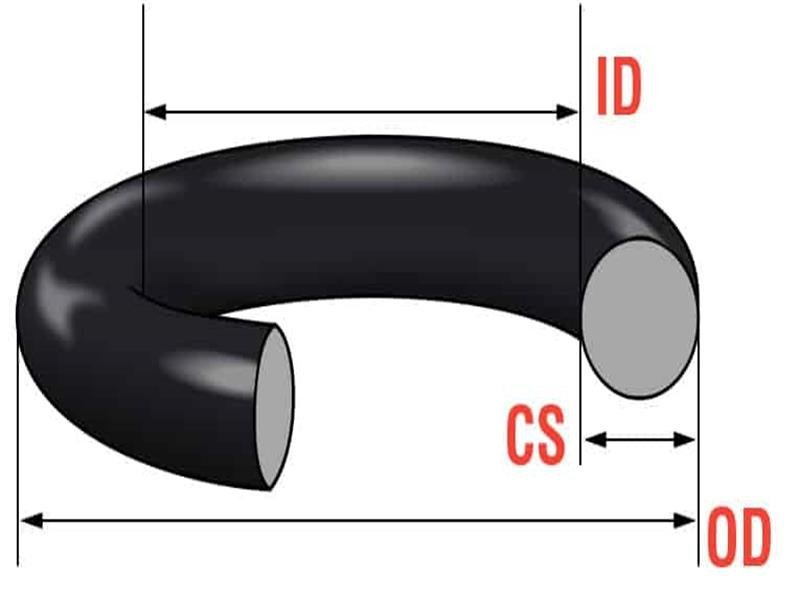
Compression refers to how much the O-Ring cross-section is compressed after installation.
- Recommended for static sealing: 15%–30%
- Recommended for dynamic sealing: 9%–25%
If compression is too low, sealing contact pressure is insufficient and leakage may occur.
If it is too high, long-term stress causes permanent deformation and loss of elasticity.
Compression is determined by groove depth. A deeper groove results in lower compression, while a shallower groove increases it.
Simple example:
An O-Ring with a 1 mm cross-section installed in a groove with 0.75 mm depth and 0.1 mm clearance:
Compression = (1 − 0.75 − 0.1) ÷ 1 × 100% = 15%
This is right at the lower limit of the recommended range for static sealing.
If you already have groove dimensions on your drawing, you can send them for verification.
Stretch — Often Ignored in External Sealing
In external sealing applications, the O-Ring is stretched slightly during installation. This is called the stretch percentage. This stretch percentage should typically stay between 3%–4% for static seals and no more than 5% maximum.
Why is this important? Because stretching reduces the cross-sectional diameter slightly, which in turn reduces effective compression. If stretch is not accounted for correctly, a design may appear adequate on paper but fail in actual sealing performance.
A simple way to estimate:
Stretch = (groove diameter − O-Ring inner diameter) ÷ inner diameter
If the value is too high, a different O-Ring size should be selected.
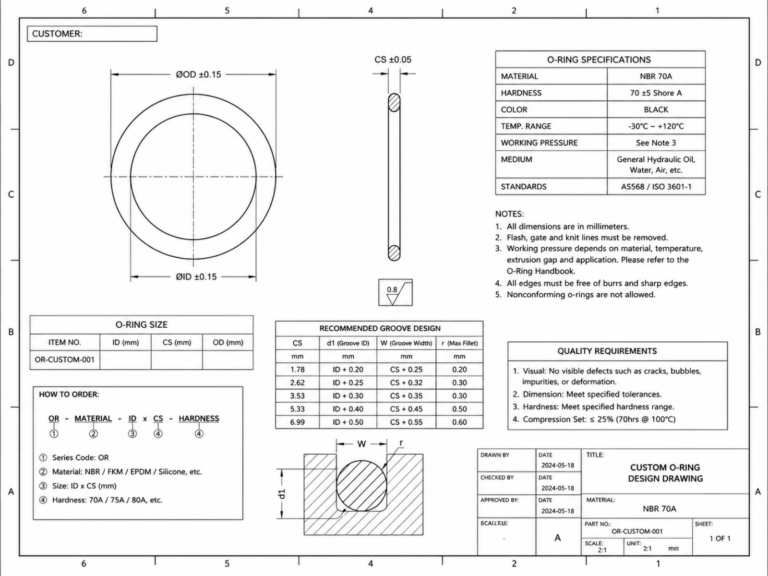
Groove Dimensions — Mark These Clearly on Your Drawings
Many customers send drawings with only O-Ring size specified, while groove details are incomplete. This leads to unnecessary delays and repeated clarification.
Key groove dimensions to specify in your O-Ring design:
- Groove Depth: Directly affects compression. For 1 mm cross-section: ~0.8 mm for internal seals, ~0.65 mm for external.
- Groove Width: Must allow room for expansion when compressed, but not so wide that the O-Ring shifts or rolls. Typically 0.05–0.1 mm wider per side than the cross-section.
- Clearance Gap: Keep it tight (usually 0.05–0.1 mm per side for static seals) to prevent extrusion and damage.
- Chamfers: Always chamfer assembly edges to avoid cutting or nicking the O-Ring during installation—a common but critical oversight.
Material Selection — Based on Working Media
Material selection is one of the most important parts of O-Ring Design. The core principle is simple: what fluid or gas will it contact, and at what temperature?There are common types of O-ring material: