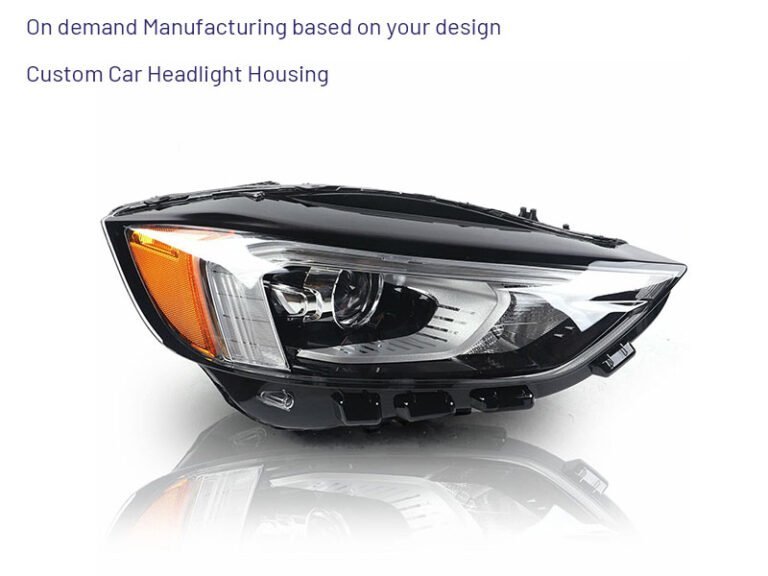
Car headlight housing plays a vital role in automotive design, serving both functional and protective purposes. In this guide, we cover what headlight housing does, why polycarbonate is the industry-standard material, how it compares to acrylic, and what to expect when ordering a custom housing.
What Is Car Headlight Housing?
Headlights fall into three functional types: long-range (high beam) lights for open roads, short-range (low beam) lights for curves and close-range visibility without blinding oncoming traffic, and turn signals, which need strong light penetration for a quick flash.
The housing protects the bulb, reflector, and internal wiring from dust, moisture, and impact, while also shaping how light is distributed—directing enough light forward for visibility without creating glare for other drivers. Because of this, housing design must also meet legal requirements for beam pattern and light output.
Polycarbonate (PC) is the standard material for headlight housings because it combines the hardness and optical clarity of glass with a fraction of the weight, and it resists cracking on impact—something glass and more brittle plastics can’t match. The inner wall is molded with a textured, slightly concave surface that helps refract and direct light output.
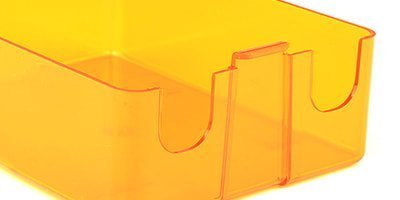
Custom PC Housing Parts
Key Functions of Custom Headlight Housing
- Carrier of Components: Houses the bulb, reflector, and wiring, keeping them aligned for consistent light output.
- Mounting to the Vehicle Body: Secures the headlamp assembly so it stays stable during operation.
- Environmental Protection: Shields internal components from moisture, heat, dust, and debris.
- Light Distribution: Directs light from the bulb through the reflector and lens for optimal visibility while limiting glare.
Internal Structure of the Headlight Housing
Layered Design
Headlight housings are typically built in three layers:
- Outer Shell: The visible, weather-facing layer, shaped for aerodynamics and styling.
- Inner Shell: Houses internal wiring and circuit pathways.
- Middle Reflector Layer: Sits between the outer and inner shells; its textured, concave surface directs and optimizes light distribution.
Shape and Opening Design
Housings are generally molded in two shapes: a parallelogram section with rounded corners for the long- and short-range beams, and a triangular side section for the turn signal. The lamp opening is sized and positioned to match the vehicle’s mounting points and beam requirements.
Polycarbonate vs. Acrylic: Which Fits Your Headlight?
The choice between polycarbonate and acrylic (PMMA) comes down to what the part needs to survive.
Acrylic offers higher light transmittance (around 92%) and resists yellowing well under UV exposure, with a harder surface that resists scratching and a lower cost. This makes it a good fit for taillight covers or other cost-sensitive, lower-impact applications—but its brittleness and low impact resistance make it a poor choice anywhere the part could take a hit.
Polycarbonate has slightly lower light transmittance (around 88%) but far higher impact resistance—commonly cited at up to 30 times that of acrylic—so it can absorb debris strikes at highway speed without shattering into sharp fragments. It also holds up across a wider temperature range, from about -40°C to 120°C. The tradeoff: PC scratches more easily than acrylic and usually needs a UV coating to hold its clarity over time, and it costs more upfront.
In short: choose polycarbonate for headlight covers, where impact resistance and safety matter most. Choose acrylic for taillights or other applications where cost and optical clarity are the priority and impact risk is lower.
Other Materials Used in Headlight Assemblies
Beyond the housing cover itself, a few other materials show up in different parts of the assembly:
- PC/ABS Alloy: Common in tail light housings and trim panels, balancing impact resistance with thermal stability.
- Modified PP: Used for structural light bodies where heat resistance and mechanical strength matter more than optical clarity.
- PBT: Selected for components needing to hold up under sustained heat, such as connectors near the bulb.
For a broader comparison of materials used in plastic housings and enclosures, see our guide to Plastic Enclosure Materials.
Custom Headlight Housing Manufacturing Process
- Drawing or sample review – We confirm dimensions and design intent based on your specifications.
- Material selection – Based on your requirements and application, we recommend the right material for strength, transparency, or heat resistance.
- Prototyping – We build a CAD-based design and prototype ahead of mass production.
- Sample confirmation – Production samples are sent for your approval before bulk production begins.
- Bulk production – Parts are produced via injection molding, with corrosion-resistant additives mixed in as needed for the application.
Work With Flexiparts for Custom Headlight Housing
We manufacture custom polycarbonate headlight housings to your drawings or samples, matching material and process to your durability, clarity, and cost requirements. See our plastic enclosure capabilities or contact us to discuss your project.