Bushings are components that reduce friction between moving parts, absorb vibrations, and support loads. The bushing size affects how well it performs these functions. An incorrect bushing size can lead to issues in stability and durability, while the right size ensures proper fit and operation.
Why Correct Bushing Size Is Important?
Choosing the right bushing size is critical for several reasons.
- First, it affects the load-bearing capacity. A bushing that is too small in diameter may not distribute forces evenly, leading to premature wear on the bushing and adjacent components. This can result in reduced handling precision and increased stress on the chassis.
- Second, bushing size impacts vibration control. If the outer diameter is larger than the housing hole, installation becomes difficult, and the bushing may not seat properly. This can cause excessive movement, leading to noise and discomfort during operation. On the other hand, a bushing with an undersized inner diameter might grip the shaft too tightly, restricting rotation and generating heat through friction.
- Third, durability is directly linked to bushing size. Proper dimensions ensure that the bushing maintains its shape under repeated loads. Incorrect bushing size can accelerate degradation, requiring frequent replacements. This increases maintenance costs and downtime.
- Fourth, the bushing size will affect the longevity of components. The right size ensures that the bushing will perform its job effectively for a longer period. Overstressed bushings that are not the right size can lead to faster degradation of the components around them, including shafts, housings, and even the bushing itself. Proper sizing helps in maintaining the balance between comfort, stability, and durability.
- Additionally, bushing size influences alignment and safety. In suspension setups, precise sizing keeps wheels aligned, which is necessary for stable steering and braking. Misaligned components due to wrong bushing size can lead to uneven tire wear and potential loss of control.
Key Dimensions of Suspension Bushings
Suspension bushings have several key dimensions that define their size and fit.
- The inner diameter (ID) is the measurement of the hole through which the shaft or bolt passes. This dimension must match the shaft closely to allow smooth movement without excessive play.
- The outer diameter (OD) is the external measurement that fits into the mounting hole. It ensures the bushing stays secure in its housing. If this dimension is off by even a few millimeters, the bushing could shift during use.
- Length, or height, determines the contact area and support provided. Shorter bushings may be used in compact spaces, while longer ones offer more stability in high-load areas.
- Some bushings include additional features like flanges. The flange diameter provides extra support against axial loads.
- Wall thickness, the difference between inner and outer diameters, affects rigidity. Thicker walls suit heavy loads, while thinner ones allow more flexibility for vibration damping.
Steps to Measure Existing Bushings
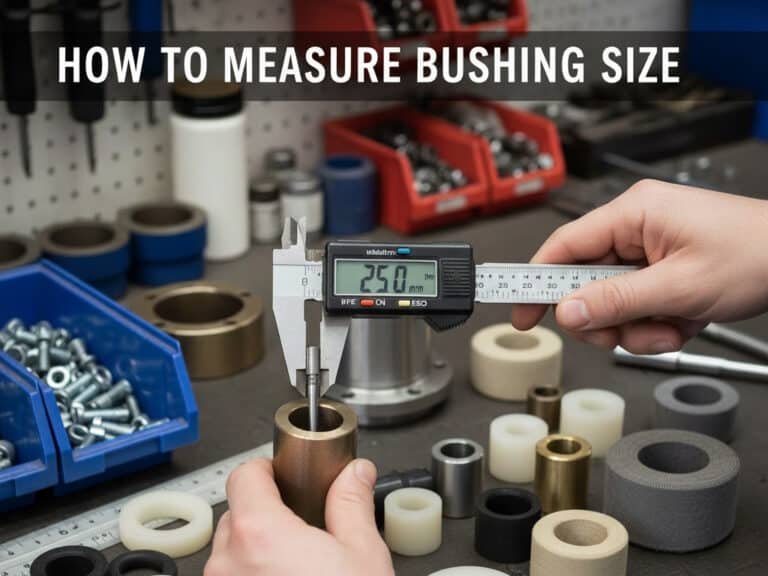
Measuring existing bushings accurately confirms whether replacement parts match the original bushing size. Follow these steps for reliable results.
- First, remove the bushing from the assembly and clean it to remove debris or old grease. Secure it in a soft-jaw vise to avoid distortion.
- Second, use digital calipers to measure the inner diameter at three points: top, middle, and bottom. Record the average and note any ovality, which indicates wear if it exceeds 0.01 mm.
- Third, measure the outer diameter similarly, checking for uniformity. Use a depth micrometer for length and flange thickness if applicable.
- Fourth, measure the length of the bushing using a caliper or ruler. The bushing length fits within a specific housing and needs to be the correct length to provide full support.
- Fifth, measure the Wall Thickness. Subtract the inner diameter from the outer diameter and divide by two.
- Finally, compare measurements to manufacturer specifications. If the bushing size falls outside tolerances, select a new part with matching dimensions.
Professional Custom Bushing Supplier
Proper bushing size selection and measurement prevent issues related to fit, durability, and safety. For complex requirements, professional custom bushing suppliers offer tailored solutions. Flexiparts uses advanced manufacturing to produce types of bushings in exact sizes, incorporating specific materials and tolerances. Contact Flexiparts and get a custom solution for your bushing project.