
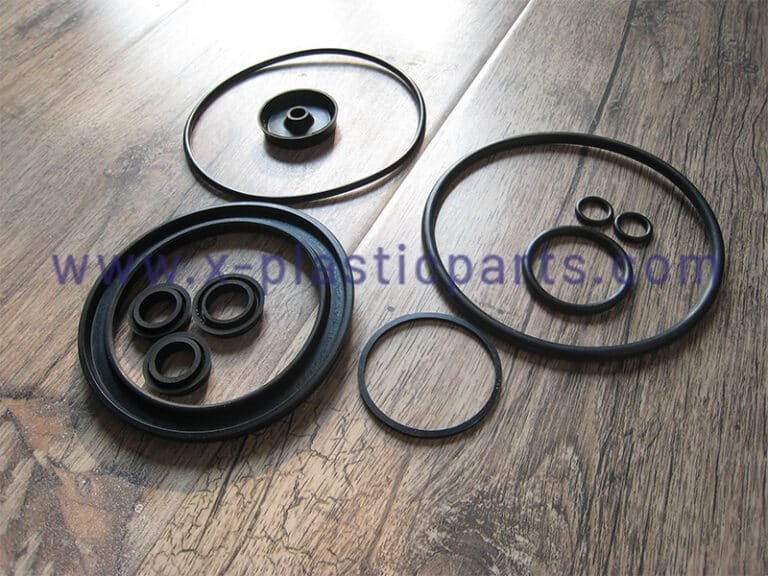
High pressure O rings are essential components in sealing systems used in fluid power, process equipment, and industrial systems. These seals handle environments where pressure levels exceed standard thresholds, ensuring no leaks occur in critical applications. The design of high-pressure O-rings involves careful consideration of multiple factors to maintain performance in high pressure environments.
What Are High Pressure O Rings?
High pressure O rings are circular elastomeric seals with a round cross-section, designed to create a barrier against fluid or gas leakage in high-pressure conditions. They function by compressing between two surfaces, filling any irregularities to form a seal.
In system design, pressure is a primary factor, as it determines how much force the O-ring must resist without deforming excessively. The gap, or clearance between the surfaces, affects the seal’s stability; larger gaps increase the risk of issues under pressure. Material will influence high pressure O rings’ durability and compatibility with the operating environment. Backup rings provide additional support, preventing the O ring from moving into the gap under high loads
How to Define “High Pressure”?
In O-ring sealing applications, high pressure is not defined by a single pressure value. Instead, it refers to operating conditions where system pressure approaches or exceeds the sealing capability of a standard O-ring design.
An application is considered high pressure when system conditions create a risk of O-ring extrusion, deformation, or seal failure, depending on pressure level, material properties, groove design, back-up ring support, and operating environment.
3 Key Variables Influencing High Pressure
Three main variables impact what is deemed high pressure for O rings:
- System Gap Size: The clearance between the sealed surfaces plays a significant role. A gap larger than 0.008 inches can make even moderate pressures challenging for high pressure O rings, as it allows for potential extrusion.
- Material Hardness and Support: Softer elastomers seal easily but deform more readily under load. Harder materials resist extrusion but require a precise groove design to maintain sealing efficiency.
- Operating Temperature and Media: Temperature affects material properties, with higher temperatures reducing the effective pressure resistance of high pressure O rings. The type of fluid or gas in contact also matters; aggressive chemicals can degrade the high pressure O ring material, effectively lowering the pressure threshold.
Why Do O Rings Fail Under High Pressure?
Failure of O rings in high pressure environments occurs due to several mechanisms. And high pressure amplifies both mechanical and material-related weaknesses.
Extrusion
Extrusion is the most common cause of high-pressure O ring failure. The elastomer is forced into the clearance gap and gradually shears or tears. This process may begin as minor surface damage and progress to complete seal failure.
Compression Set
Sustained high pressure increases compressive stress, accelerating permanent deformation. Once compression set occurs, the O ring loses its ability to maintain sealing force.
Material Cracking or Rupture
Material burst occurs when internal stresses surpass the tensile strength of the high pressure O ring material, causing cracks or splits, especially at elevated temperatures or in aggressive media.
Installation Damage
Cuts, twists, or surface abrasions introduced during installation become critical under high pressure. Defects that might be tolerable at low pressure often propagate quickly in high-load environments.
How to Choose High Pressure O Ring Material?
Material selection is one of the most influential factors in high-pressure sealing performance. The choice of high pressure O ring material must balance mechanical strength, elasticity, chemical compatibility, and temperature resistance.
Hardness (Durometer)
Higher durometer materials provide better resistance to extrusion. However, increased hardness reduces the ability to conform to surface irregularities, requiring more precise groove geometry.
Tensile and Tear Strength
Materials with higher tensile strength are better suited to resisting deformation and tearing under pressure.
Chemical Compatibility
Chemical resistance remains a baseline requirement. A mechanically robust material is ineffective if it degrades in the operating fluid.
Temperature Stability
Temperature affects both elasticity and strength. High temperature combined with high pressure can accelerate material breakdown.
Common high pressure O ring material options include high-durometer NBR, FKM, and specialty polyurethane compounds, depending on the application environment.
When and How to Use Backup Rings?
Backup rings are designed to prevent extrusion by physically blocking the O ring from flowing into clearance gaps.
When Backup Rings Are Required:
Backup rings are required when system pressure and clearance exceed the extrusion limits of the O ring material. In high-pressure applications where clearances cannot be further reduced or operating conditions (dynamic movement and temperature)increase deformation risk, backup rings provide essential support to prevent material flow and maintain sealing stability.
How to Use Backup O Rings:
Types include spiral, solid, or V-shaped designs, often made from PTFE or nylon. Installation involves placing the backup ring in the groove first, followed by the O ring, ensuring no twisting occurs. Lubrication during assembly aids in positioning without damage. In cases of very high pressure, dual backup rings on either side of the O ring enhance protection. Regular inspection after installation confirms proper seating, as misalignment can reduce effectiveness.
Groove Design and Installation Tips for High-Pressure O-Rings
Groove design directly impacts the performance of high pressure O rings.
Groove Dimensions
Grooves must maintain adequate squeeze while minimizing extrusion gaps. The groove width should be 1.5 to 2 times the O ring’s cross-section diameter, with depth allowing 20-30% compression.
Surface Finish
Rough surfaces increase wear and accelerate damage under pressure. Surface finish should be Ra less than 16 microinches to avoid abrasion.
Edge Conditions
Sharp edges can cut or nick O rings during installation. Chamfers and lead-ins can avoid sharp edges.
Installation Practices
Installation requires clean surfaces and tools to prevent damage. Apply compatible lubricants to the O ring, then compress it gradually into the groove. Avoid stretching, twisting, or forcing O rings into position.
Typical Applications of High Pressure O Rings
High pressure O rings are widely used across industries where fluid containment and mechanical reliability are critical.
- Hydraulic systems: pumps, valves, cylinders
- Oil and gas equipment: wellhead components, control systems
- Chemical processing: high-pressure reactors and transfer lines
- Industrial machinery: presses, injection systems, power units
- Aerospace and defense: actuators and fluid control assemblies
Custom High Pressure O Rings from Flexiparts
High pressure O rings are defined by system demands rather than by a single specification. Pressure, clearance, material properties, groove design, and backup support all interact to determine sealing performance and service life. For tailored solutions, Flexiparts offers custom high pressure O rings based on specific requirements. Contact Flexiparts for consultations on your sealing needs.