Enclosure design is not merely about creating a protective shell. It is a multidisciplinary engineering task that directly affects product durability, assembly efficiency, and overall manufacturing cost. In injection molding, even a minor design decision—such as wall thickness variation, gate placement, or material selection—can significantly influence whether a part performs reliably or fails during production.
A well-designed plastic enclosure ensures structural integrity, consistent quality, and predictable production cycles. A poor design does the opposite. Warpage, sink marks, and assembly misalignment. These are not random defects. They are often the direct result of overlooked design principles.
Why Electronic Enclosure Design Matters?
From a functional standpoint, the enclosure protects sensitive internal components from mechanical impact, dust, and environmental exposure. For industrial or outdoor applications, it also determines IP ratings and long-term reliability.
From an engineering perspective, enclosure design defines how well the part can be manufactured. Poor draft angles increase ejection force. Uneven wall thickness leads to inconsistencies in shrinkage. Complex geometries raise tooling costs.
From a business standpoint, the enclosure affects both cost and scalability. A design optimized for injection molding reduces cycle time, minimizes scrap rates, and ensures stable mass production. Conversely, an inefficient design increases tooling revisions and delays time-to-market.
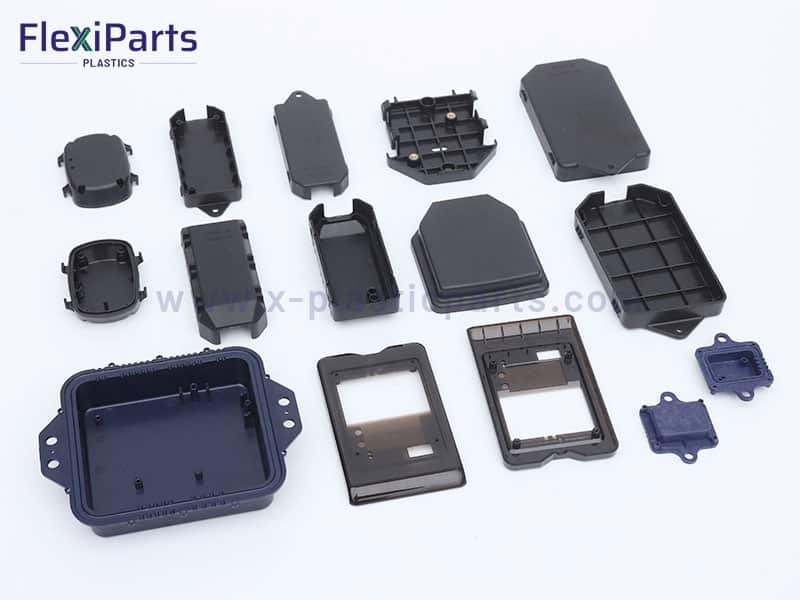
Custom Injection Molding Enclosure Design Guide
Successful plastic enclosure design for injection molding requires careful attention to numerous technical details.
Right Material Selection
Material selection determines not only mechanical performance but also process stability. Common choices include:
- ABS: cost-effective, easy to process, suitable for general-purpose enclosures
- PC: high impact resistance, clarity, and dimensional stability
- PC+ABS blends: balanced strength, toughness, and processability
- PP: chemical resistance and low cost,
- Nylon: superior mechanical strength.
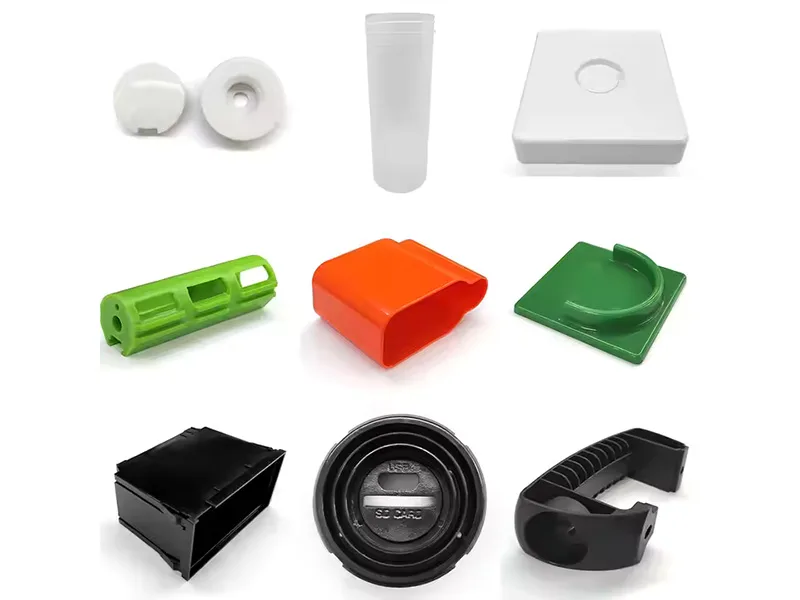
The selection process must consider the end-use environment. Outdoor enclosures may require UV stabilizers and weather-resistant grades, while medical enclosures often need FDA-compliant or sterilizable resins. For electronics, flame-retardant grades meeting UL94 standards and materials with low outgassing properties are frequently specified. Material shrinkage rates also vary significantly and must be factored into dimensional tolerances. Flexiparts is experienced with plastic injection molding, and we will recommend the right material for the customers.
Optimize Wall Thickness Design
Uniform wall thickness is a fundamental principle in injection molding. Typical ranges fall between 1.5 mm and 3 mm, but consistency matters more than absolute thickness. Uneven sections lead to differential cooling, leading to warping, sink marks, or internal voids. During DFM review, we recommend optimized wall transitions and, where necessary, structural alternatives such as ribs instead of increasing thickness. This approach improves strength without sacrificing manufacturability.
Adding Ribs and Bosses
Ribs and bosses are widely used to reinforce enclosures and support assembly features. Rib thickness at 50–70% of nominal wall thickness. Boss structures supported by ribs to prevent stress concentration. In real production, poorly designed bosses often lead to cracking or visible sink marks. We help customers refine these structures by balancing mechanical strength with molding constraints, ensuring reliable assembly without cosmetic defects.
Proper Draft Angles and Demolding
An adequate draft is essential for successful ejection in injection molding. Most vertical surfaces in an enclosure should incorporate a draft angle of 1° to 3° for smooth textures and up to 5°–8° or more for textured surfaces. Insufficient draft increases the risk of part sticking, scuffing, or excessive mold wear. Good draft practices are particularly important in deep cavities or tall features commonly found in electronic enclosures.
Adding Fillets and Smooth Transitions
Sharp corners create stress concentrations that can lead to cracking under load or during molding. We can add fillets to avoid those issues. Internal fillets should be approximately half the wall thickness, while external radii should match the wall thickness to maintain uniform thickness. We typically recommend consistent radii throughout the design and smooth transitions to improve melt flow. Those design tips will support both mechanical performance and stable molding.
Proper Gate Location, Flow, and Filling
Gate placement significantly affects filling patterns, weld line locations, and final appearance. Gates should be positioned in non-visible areas, such as the inside of ribs or along the bottom edge. Proper flow design eliminates short shots, burn marks, and air traps. For complex enclosures, we use mold flow analysis to evaluate filling behavior and optimize gate placement. This reduces trial-and-error during mold testing and shortens development time.
Consider Tolerance and Fit
Tolerance design must account for real manufacturing conditions. Overly tight tolerances increase cost and rejection rates. A balanced approach ensures both functionality and manufacturability. We help customers define proper clearances for snap-fit structures, reliable screw assembly interfaces, and realistic tolerances based on material shrinkage.
Surface Finish and Texture
Surface texture influences both aesthetics and functionality in plastic enclosure design. Matte or leather-grain textures can hide minor imperfections and improve grip, while high-gloss surfaces demand stricter control of wall thickness uniformity. Texture direction and depth should be decided early because they affect draft requirements and demolding performance. We assist clients in selecting finishes that align with both aesthetic goals and molding constraints, ensuring consistent results in mass production.
EMI / ESD Protection Integration
For many electronic products, EMI and ESD protection are essential. We support integration through conductive coatings, shielding structures, and grounding design optimization. These features must be considered early. Integrating them at the design stage avoids costly redesigns later in the project.
Common Types of Electronic Enclosures
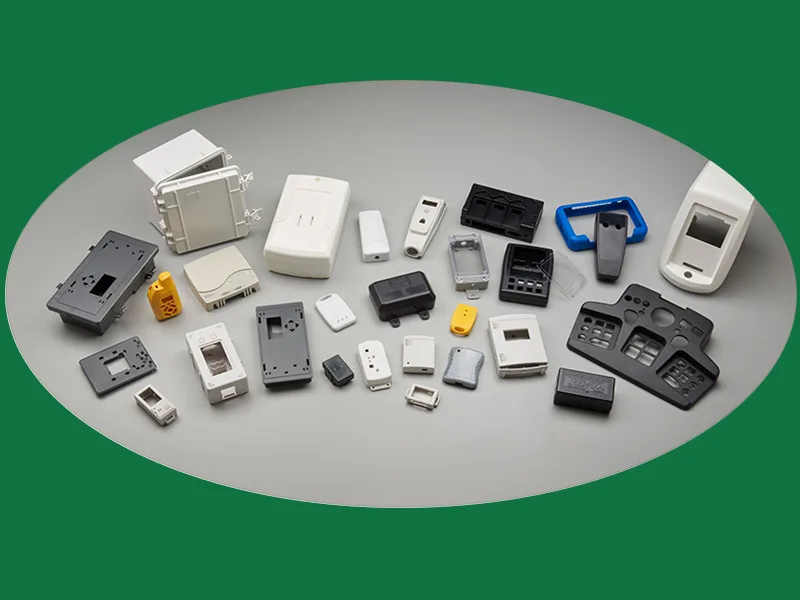
Custom plastic enclosures come in various forms to suit different applications.
Handheld Device Enclosures
These enclosures prioritize ergonomics, lightweight construction, and drop resistance. Common examples include remote controls, barcode scanners, and portable medical instruments. Design focus often includes comfortable grip textures, precise button openings, and secure battery compartments. Snap-fit features minimize screws and speed up assembly.
Embedded and Desktop Device Enclosures
Used for routers, set-top boxes, and benchtop instruments, these enclosures emphasize thermal management through ventilation slots, clean port layouts, and stable desktop positioning. Wall-mount or rubber feet options are common. Aesthetics tend to be sleek and minimalist, with snap-fit or hidden fasteners for a clean look.
Industrial and Outdoor Enclosures
Designed for harsh environments, these plastic enclosures must achieve high IP ratings (IP65 and above), resist corrosion, and handle wide temperature swings. Thicker walls, robust ribs, and reinforced mounting points are typical. Color and texture choices consider long-term UV and weather exposure. Cable glands and sealed connectors are often integrated.
Special Custom Enclosures
These custom enclosures often feature complex or high-end applications; we provide prototyping and customized solutions, including multi-material molding and advanced tooling strategies.
Conclusion
Enclosure design is most effective when it is aligned with manufacturing from the beginning. Design decisions influence not only product performance, but also production efficiency and overall cost. From material selection and DFM analysis to mold development and mass production, Flexiparts provides end-to-end support for custom plastic enclosures. Welcome to contact us and get a custom solution for your project.